media chinwag

Musings on Journalism in the Online Age

Month: September, 2015

The Press, the Public, and the President

Leslie T. Chang has a good report in NYR Daily titled “Egypt’s Media: Endorsing Repression.” She writes on how journalists, perhaps notably the country’s influential political talk show hosts, are making energetic efforts to build a consensus behind the policies of President Abdel Fattah El-Sisi. It seems to be helping: the leader’s approval rating after a year in office was around 90 percent.

Abroad, the Sisi administration is criticized for allowing more than a thousand people thought to be sympathetic to Morsi to be sentenced to death in mass trials; in Egypt, newspaper columnists say they should be executed without trial. Journalists occasionally criticize government performance on issues like education, health care, or religious policy. But as I discovered in interviews with leading talk show hosts and editors, they regard the defining feature of Sisi’s administration—the use of state-sanctioned violence and politicized trials to maintain order and crush its opponents—with near-unanimous approval.

media control

Chang reports on El-Sisi’s moves to influence the media, holding monthly meetings with editors and presenters, and telling television hosts they are responsible “for promoting unity and raising morale.”

As Chang notes, it’s not simply an issue of control from above. Egyptian journalists, especially those working for the independent media, were increasingly free to report during the last years of the Hosni Mubarak era—criticism of the president and even his family was tolerated. Journalists briefly became more assertive in their watchdog role after the January 25, 2011 uprising that ended Mubarak’s 30-year rule. In one of the most celebrated examples, Ahmed Shafik, an interim prime minister, abruptly resigned from office after being aggressively questioned on Baladna bel Masry, a political talk show on ONTV hosted by Reem Magued.

But the Egyptian public mood has become deeply fearful of instability, due to the polarizing presidency of the Muslim Brotherhood’s Mohammed Morsi, the protests and violence involved in his removal from office, the rise of jihadist chaos throughout the Arab word including in Egypt, and the nosedive of the Egyptian economy. El-Sisi is seen by millions as the nation’s protector—and only hope. Many journalists share the fears, or at least are influenced by the public’s intolerance for any further destabilization of the state. (The logic was no doubt at play last week in the Egyptian government’s ban on media coverage of the Egyptian military’s lethal attack on suspected insurgents who turned out to be Mexican tourists—few Egyptians want to see their army’s honor besmirched.)

Chang concludes:

In the two years since the army removed Morsi after huge demonstrations against him, the mainstream media has lost most of the openness it briefly enjoyed. Especially during major political events, the press speaks in one voice; journalists who break ranks sometimes find themselves vilified—not by the government but by their own colleagues and the public.

Egypt’s revolution taught the world that the power of a dictator can dissolve in an instant. But the lesson of the years since may be that, in a country threatened by chaos and violence, authoritarianism can hold a powerful appeal of its own.

—Scott MacLeod

Vacating the Tower of Truth

We all know too well how the technology-driven disruption of the news business has led newspapers to slash their staffs—nearly 23,500 jobs (out of 56,400) at U.S. daily newspapers since 2001. David Uberti has a neat follow-up piece in the September/October 2015 Columbia Journalism Review—on the demise of America’s great newspaper buildings. (See a related piece by Tim Adams in the Guardian.)

newspaper buildings

Some of the landmark edifices were actually destroyed once journalists had been re-located to less expensive digs—One Herald Plaza, the Miami Herald headquarters on Biscayne Bay since 1963, pictured here, was torn down last year by the property’s new owner, a Malaysian casino operator. The art deco Inquirer Building, home to the Philadelphia Inquirer for 87 years, nicknamed the “Tower of Truth,” was purchased in 2011 by a property developer who wants to turn it into a hotel. Symbolizing the struggles of the Inky, which had been sold five times in six years, the remaining staff moved to smaller premises a year later. Other papers that vacated historic sites in recent years include the Detroit News and Detroit Free Press, Atlanta Journal-Constitution, Cleveland’s Plain Dealer, and Chicago Sun-Times, among others.

Uberti’s CJR cover story nicely captures the nostalgia for the pre-digital newspaper trade. He quotes the late journalist Al Martinez’s 2007 reflection on his old Oakland Tribune newsroom:

We were a brotherhood of young lions back then, working hard through a half-dozen deadlines a day and drinking hard. We did it, we told ourselves, for the people’s right to know, and affixed it like a knight’s pennant to the end of a spear.

But Uberti’s piece, headlined “Why the sale of old newspaper buildings isn’t all bad,” points out that the fading businesses can use the cash to pay down debt or reinvest in new products. And there’s more. He writes:

After the Inquirer departed the Tower of Truth, Inga Saffron, the newspaper’s architecture critic, was optimistic that it could forge a new identity elsewhere. “Making our home in a newspaper building froze us psychologically in history, and kept us from interacting physically in the city,” she wrote in a 2012 Inquirer column. “The future for all media is an interactive one.” In that environment, she added the next year in a New Republic piece, “the most valuable real estate is online.”

Such new offices certainly won’t solve newspaper companies’ long-term financial problems. But they’re a symbolic step forward into the unknown, an acknowledgement that there’s no going back to what came before, however glorious it was. The resulting psychological benefits can’t be overstated, especially for the younger generation on whose shoulders the fate of journalism rests. If the companies that formerly produced only newspapers have any chance of survival, they will need that energy—not the baggage that accompanied vaunted historical headquarters.

This job isn’t as noble as it seems, most journalists would admit, but it’s as noble as any job is going to get. The real reason it’s so difficult to let go to of aging buildings is that they’re relics of an era in which journalism was simply a calling, not a struggling business with corporate ownership, quarterly earnings reports, not enough money coming in, and too many journalists going out. The physical structures remind us of a time when those in our profession felt in control of their own destiny.

—Scott MacLeod

The Alan Kurdi Debate

The photograph of a lifeless 3-year-old Syrian boy face down on a Turkish beach shocked us to the core. It appeared on front pages, news websites, Twitter feeds, Facebook posts, and television broadcasts around the world, bringing unprecedented attention to the Syrian refugee tragedy.

Le Monde page 1ok

The boy, Alan Kurdi (evidently wrongly identified in news media accounts as Aylan Kurdi initially), was among the steady flow of desperate Syrians seeking refuge in Europe aboard small and overcrowded vessels crossing the Mediterranean Sea. Strong waves apparently forced the boat carrying Alan to capsize, leading to the deaths of 12 people including the boy’s mother and 5-year-old brother.

The image of Alan, taken on September 2, sparked a debate about whether publishing the photograph was journalism or voyeurism. Many media organizations showed reluctance to run it, instead opting for a frame showing his partially obscured body being carried away by a Turkish police officer. Max Fisher writes in Vox: “There is a line between compassion and voyeurism. And as that photo was shared and retweeted over and over again, converted into listicles and social-friendly packages, it felt more and more like the latter.” Many shared the feeling that the image was another violation, and that withholding the image showed respect for human dignity.

Such concerns are valid, which is why the decision to publish or not to publish was debated so thoroughly in many newsrooms. But in this instance the photo achieved the higher journalistic purpose of informing the world about news that we need to know about. It did so in a way that humanized a tragedy that has otherwise become numbingly familiar with almost daily accounts of refugees fleeing new conflict zones or drowning in the sea.

Aiden White, writing in openDemocracy, where he includes some good links to the discussion, argues that the disturbing image helped media and social networks “shape the refugee crisis into a more sensitive, humanitarian and people-focused story.” Indeed, the image prompted debates from Britain to Australia on whether leading developed nations were doing enough to alleviate the humanitarian crisis including taking in higher numbers of refugees. British Prime Minister David Cameron and French President François Hollande were reported to have been personally moved by the image. On September 10, President Barack Obama announced that the United States would admit 10,000 refugees over the next year, compared to 2,000 this year. Senator John McCain presented a blow-up of the photo on the floor of the United States Senate to urge stronger American leadership in the Syrian crisis.

Aiden White noted how the Alan Kurdi photo even seemed to change some hard-line attitudes inside newsrooms :

Some media were forced to reverse their previously hostile coverage of refugees. The Sun, Britain’s leading tabloid newspaper, quietly erased its promotion of dehumanising rhetoric from columnist Katie Hopkins who in April referred to Mediterranean refugee victims as “cockroaches” and said: “Show me bodies floating in water, play violins and show me skinny people looking sad. I still don’t care.”

In Germany, Bild, the country’s best-selling newspaper, performed a dramatic act in response to a public uproar over its decision to use the image: on September 8, it published its print and online editions with no photos at all. In France, Le Monde director Jérôme Fenoglio defended his paper’s decision in a front-page editorial: “No voyeurism, no sensationalism here. But the will to capture a part of the reality of the moment. Maybe it will take this photo for Europe to open its eyes.” Olivier Laurent has a good discussion of the newsroom decision-making on TIME magazine’s Lightbox blog.

The photo of Alan was taken by Nilüfer Demir of the Turkish Dogan News Agency, who explained her actions in an interview here.

AFP’s Bülent Kiliç, the Turkish photographer who won the World Press Photo 2015 contest for the best spot news photograph (covering the Istanbul protests in 2014), has done superb work documenting the tragedy of the Syrian refugees this year. Check out a gallery of his photos here.

The United Nations High Commissioner for Refugees reported in August that more than 4 million Syrians had registered as refugees with the agency. The UNHCR reports that more than 300,000 refugees from Syria as well as other conflict zones like Iraq and Afghanistan arrived in Europe via Mediterranean crossings so far in 2015. This year as of August some 2,500 refugees and migrants are estimated to have died in the process; the figure was 3,500 for all of 2014.

—Scott MacLeod

Innovating at the New York Times

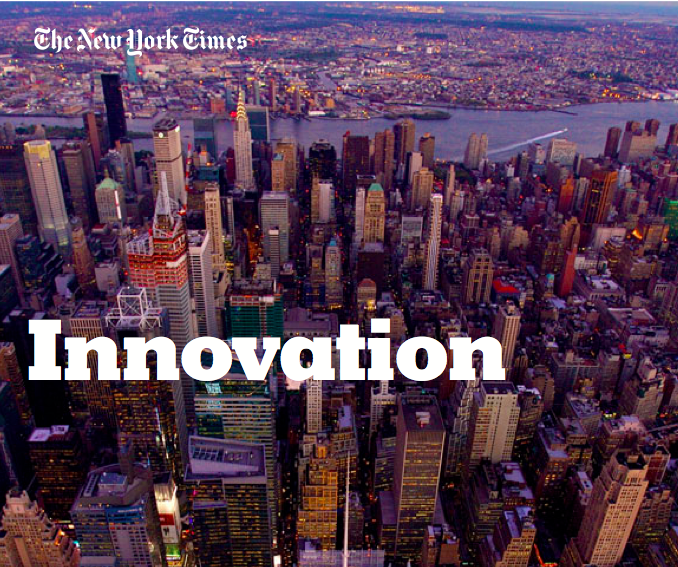
In March 2014, the New York Times produced a report titled “Innovation,” a fascinating internal study of the American news business in general and the Times in particular. The study (soon leaked on the Internet—download it here) candidly admitted that the paper’s readership was falling—including its audience online and on smartphone apps—and something needed to be done about it as a matter of urgency.

innovation

The fate of the New York Times is a concern for all of us. Whatever its flaws, the Times is the best newspaper in the world—if we judge it on the basis of the depth, breadth, and excellence of its reporting and commentary. Countless successful online media organizations are what they are today because they aggregate or pinch New York Times journalism. American democracy is suffering from the demise of legacy media institutions, and the fall of the Times would be an unbearable blow—an end to quality journalism as Americans know it.

The Innovation report made various recommendations to Times executives under the headings of “Growing Our Audience” and “Strengthening Our Newsroom.” One of the recommendations was for a belated but nonetheless revolutionary step: “Map a strategy to make the newsroom a truly digital-first organization.” Note the words: Digital-First.

Lately, some observers have been assessing how the Times is doing since the Innovation report was issued. A few views: here, here and here.

The consensus seems to be that the paper is taking the recommendations very seriously. Arthur Gregg Sultzburger, who led the Innovation team and is the son of the Times’ publisher, has spent the past year heading the Newsroom Strategy team on digital transformation. He has now been promoted to associate editor of the Times.

—Scott MacLeod

The Scoop on HuffPost Arabi

huffpostarabi

HuffPost Arabi is off to a surprisingly rocky start. There was a good rundown of the problems recently on Brian Whitaker’s Al-Bab blog:

DIDN’T Arianna Huffington realise what she was getting into when she decided to launch HuffPost Arabi? In the first three weeks it has certainly been attracting attention, but mostly of the wrong sort.

The new Arabic-language website was born amid a show of bravado from Ms Huffington. Avoiding “any kind of censorship and control,” she said, would be “absolutely key”. For that reason it would be operating from London and Istanbul rather than any of the Arab countries, and would pursue stories “relentlessly”.

She also vowed to back the website’s writers to the hilt. “We will support [contributors] in every way,” she said. “Anyone persecuted for opinions published on the site” would be given legal funding and “extensive coverage” across other sections of Huffington Post.

But promising that kind of blanket support to largely unknown writers for as-yet-unwritten articles was inviting trouble – especially considering that the editorial director of Huffington Post’s Arabic offshoot is a Qatari known for his pro-Islamist stance and its Egyptian editor-in-chief is a self-declared member of the Muslim Brotherhood.

Read Whitaker’s entire article here. Among the problems he cites: an article by an Egyptian writer that castigated gays that Huffpost Arabi found it necessary to delete; a rosy tribute to the late Taliban leader Mullah Omar by the former Al Jazeera correspondent in Afghanistan; and an essay by an Algerian researcher denouncing selfie photographs as “sick.”

This is what the Independent had to say when HuffPost Arabi launched in July. Check out Arianna Huffington’s launch announcement.

Huffington spoke about HuffPost Arabi and her ever expanding international reach in an interview with me for the Cairo Review of Global Affairs Winter 2015 edition.

—Scott MacLeod