media chinwag

Musings on Journalism in the Online Age

Month: October, 2015

Chasing the Bin Laden Story

Reporters like to think of themselves as empiricists, but journalism is a soft science. Absent documentation, the grail of national-security reporting, they are only as good as their sources and their deductive reasoning. But what happens when different sources offer different accounts and deductive reasoning can be used to advance any number of contradictory arguments?

Jonathan Mahler poses this good question in a lengthy report on investigative journalism in the New York Times Magazine this week. The headline on the piece is “What Do We Really Know About Osama bin Laden’s Death?,” but the piece is essentially an examination of how investigative reporters operate. It follows how they—and others, such as the makers of the Hollywood blockbuster Zero Dark Thirty—told the story of the Bin Laden raid in Abbottabad, Pakistan in 2011.
hersh-lrb

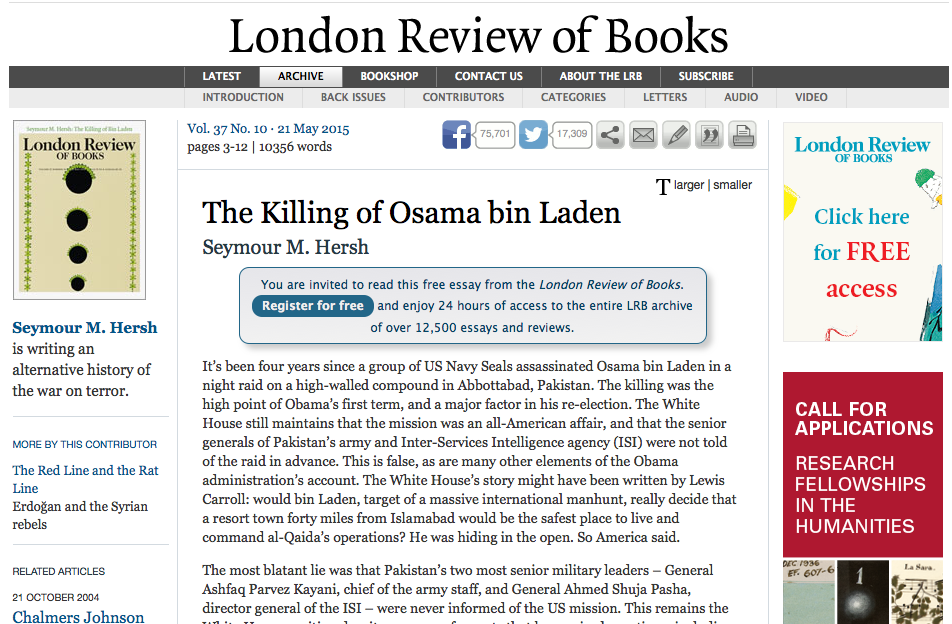
Mahler’s piece focuses on the 10,000-word article by celebrated investigative reporter Seymour Hersh in the London Review of Books, which strongly challenged the narrative of the Bin Laden raid developed by the Obama administration as well as by a number of journalists. To Hersh, famous for his stories on the My Lai Massacre and the Abu Ghraib prison abuse among many others, “the story stunk from Day 1.”

Hersh disputed the official line that Bin Laden was located due to years of methodical intelligence gathering, reporting instead that it was a tip off from a retired Pakistani intelligence officer. Rather than being a daring raid on Abbottabad, Hersh reported, Pakistani authorities were informed about the mission and allowed the U.S. Navy Seals to enter Pakistan airspace to conduct it. Hersh even reported that the Obama administration’s claim that Bin Laden had been given an Islamic burial at sea was a lie; instead, Hersh wrote, the Seals apparently tossed what was left of Bin Laden’s body out of a helicopter. The White House spokesman trashed Hersh’s story, calling it “riddled with inaccuracies and outright falsehoods.”

Although Mahler did not set out to corroborate or challenge Hersh’s account, in the end he cites a number of reports and viewpoints that prompt him to conclude that “many of Hersh’s claims could be proved right”—for example, Times correspondent Carlotta Gall had reported in 2014 on Pakistani complicity in sheltering Bin Laden.

Mahler concludes that we don’t know the whole truth of the Bin Laden raid, and it’s not only because the government is keeping it a secret: “There’s also the more modern, social-media-savvy approach: Tell the story you want them to believe. Silence is one way to keep a secret. Talking is another. And they are not mutually exclusive.”

It’s worth noting in this context, as Mahler does, that the Central Intelligence Agency reportedly cooperated with the makers of Zero Dark Thirty, who would lay claim to telling the definitive narrative of ‘‘the greatest manhunt in history.’’
obl-nyt

Hersh deserves the last word on narrative writing. As he told Mahler: “Of course there is no reason for you or any other journalist to take what was said to me by unnamed sources at face value. But it is my view that there also is no reason for journalists to take at face value what a White House or administration spokesman said on or off the record in the aftermath or during a crisis.”

At age 78, Hersh retains the fierce skepticism about government secrecy and official spin that he has been known for since breaking the My Lai Massacre story in 1969:

I love the notion that the government isn’t riddled with secrecy. Are you kidding me? They keep more secrets than you can possibly think. There’s stuff going on right now that I know about—amazing stuff that’s going on. I’ll write about it when I can. There’s stuff going out right now, amazing stuff in the Middle East. Are you kidding me? Of course there is. Of course there is.

Postscript: For some insights into how Hersh operates as a freelance journalist and investigative reporter, read the interview with him in Slate probing his Bin Laden story in LRB.

—Scott MacLeod

A Tribute to Éric Rouleau (1926–2015)

Éric Rouleau had a deep relationship with Egypt and the Middle East—he was Le Monde’s correspondent in the region for 30 years, and later served as France’s ambassador to Tunisia and to Turkey. He was born in Cairo, began his journalism career on the Egyptian Gazette, and maintained a lifelong attachment to his native country.

A tribute to Éric will be held in Cairo on October 13 on the occasion of the Arabic translation of Éric’s final work, Dans les coulisses du Proche-Orient: Mémoires d’un journaliste diplomate (1952-2012). The event is hosted by American University in Cairo’s Middle East Studies Center, the Institut Francais d’Egypte, and the Al-Tanany Publishing House.

eric

One of the speakers is longtime Le Monde Diplomatique Editor-in-Chief Alain Gresh, who wrote a poignant appreciation of Éric’s life and career in Orient XXI last March. A translation appears in the Cairo Review of Global Affairs. Here’s a brief excerpt:

In 1985, Rouleau transitioned to a diplomatic career at the request of President Mitterand. He was appointed ambassador, first to Tunis—then headquarters of the Arab League, and the city where the Palestinian Liberation Organization sought refuge after its expulsion from Beirut in 1982—and later to Ankara. After this time, only diplomats would benefit from his culture, analyses, and countless connections. Ironically, Rouleau himself noticed that the number of his readers dropped from hundreds to two, and even sometimes one—the president of the Republic.

During the first meeting of French ambassadors held in Paris after his appointment, each of the diplomats introduced themselves and their country of assignment—for example the Ivory Coast, Jordan, Argentina, etc. When it was his turn, he stood up and said: “Éric Rouleau, Le Monde.” There was silence, then the audience broke into laughter. Freud believed that slips of the tongue expressed unconscious desires. Did Rouleau consider himself the ambassador of the daily newspaper? Or did he see himself as ambassador to the world, monde in French, as he crossed from north to south? Or, might he have simply meant that he was our ambassador to a planet whose glitches he would help us solve?

Also, read “Cairo: A Memoir,” by Éric Rouleau in the Summer 2012 edition of the Cairo Review.

5029_MESC-Eric Rouleau-2-Sep2015_1

“A Tribute to Éric Rouleau (1926–2015)” will be held in Oriental Hall, AUC Tahrir Campus, from 6 p.m. to 8:30 p.m. on Tuesday October 13.

—Scott MacLeod


Are Millennials Newsless?

In a column in The Hill earlier this year titled “The young and the newsless,” Washington strategy consultant Mark Mellman summed up a number of studies indicating that young Americans are not paying attention to politics and public affairs. Data suggested that Millennials—young adults aged 18–34—don’t follow news online, in newspapers, or on television. “The simple truth,” Mellman argued, “is that young people do not like news.”

For another take on this issue, see the studies issued in 2015 by the Media Insight Project, a collaboration of the American Press Institute, Associated Press, and NORC Center for Public Affairs Research at the University of Chicago: “Breaking Down the Millennial Generation: A Typology of Young News Consumers,” issued in September; and “How Millennials Get News: Inside the Habits of America’s First Digital Generation,” issued in March.

millennials-photo

The March study found that nearly two-thirds of American Millennials “keep up with what’s going on in the world and/or read or watch news.” The study said that the young people are getting their news through networks such as social media, rather than traditional “news sessions”—sitting down to read the daily newspaper, or switching on World News Tonight every time the clock strikes 6:30 p.m.

For Millennials, the study reported:

Keeping up with the world is part of being connected and becoming aware more generally, and it often but not always occurs online. In many cases, news comes as part of social flow, something that may happen unexpectedly and serendipitously as people check to see what’s new with their network or community of friends… This generation tends not to consume news in discrete sessions or by going directly to news providers. Instead, news and information are woven into an often continuous but mindful way that Millennials connect to the world generally, which mixes news with social connection, problem solving, social action, and entertainment…

By any number of measures, staying in touch with the world is an important part of the lives of the first generation of digital adults…

Millennials are hardly newsless, uninterested, or disengaged from news and the world around them.

A few key points in the study:

Receiving news through networks may broaden rather than restrict exposure to different ideas:

Contrary to the idea that social media creates a polarizing “filter bubble,” exposing people to only a narrow range of opinions, 70 percent of Millennials say that their social media feeds are comprised of diverse viewpoints evenly mixed between those similar to and different from their own. An additional 16 percent say their feeds contain mostly viewpoints different from their own. And nearly three-quarters of those exposed to different views (73 percent) report they investigate others’ opinions at least some of the time—with a quarter saying they do it always or often.

Millennials are actually willing to pay for information, but tend to feel that news should be freely available for all:

When it comes to paying for the news, 40 percent of Millennials report paying for at least one subscription themselves, including a digital news app (14 percent), a digital magazine (11 percent), a digital subscription to a newspaper (10 percent), or a paid email newsletter (9 percent). When subscriptions used but paid for by others are added, that number rises to 53 percent who have used some type of paid subscription for news in the last year.

Interestingly, this digital generation is more likely to have paid for non-digital versions of these products. For instance, 21 percent say they have paid in the last year for a subscription to a print magazine, and 16 percent for a print newspaper, rates that are higher than for digital versions of the same products.

News publishers also may have some work to do in the digital space when it comes to subscriptions. In the qualitative interviews, we heard the notion that, because news is important for democracy, people feel they should not have to pay for it. It should be more of a civic right because it is a civic good.

Facebook and search engines like Google are critical pathways for Millennials’ acquisition of news information:

Facebook has become a nearly ubiquitous part of digital Millennial life. On 24 separate news and information topics probed, Facebook was the No. 1 gateway to learn about 13 of those, and the second-most cited gateway for seven others…

When Millennials want to dig deeper on a subject, search is the dominant method cited by 57 percent (and it is the one cited most often as useful).

The September study classifies Millennial news consumers into four categories: the Explorers and the Activists (the groups more likely to seek out news and information online) and the Unattached and the Distracted (well, you get the idea). Eight-five percent and 80 percent of Explorers and Activists, respectively, regularly go online to learn what’s going on in the world; and 44 and 51 percent pay for a news subscription (compared to 31 and 40 percent of the Unattached and the Distracted).

The API-AP-NORC studies may prove that Millennials are not completely “newsless,” but I am not too reassured. The finding on search engines may highlight the problem: when Millennials want to dive deeply into a topic, fewer than 5 percent turn to a national newspaper (in print or online) and the figure is about the same for local newspapers. The study seems to confirm that young people do not fully understand and appreciate the importance of journalism in our societies—the presentation of reliable news by professionals using a well-developed discipline for assembling, verifying, and being accountable for facts. As the Center for News Literacy at the Stony Brook University School of Journalism warns:

News aggregators, bloggers, pundits, provocateurs, commentators and “citizen journalists” are competing with traditional journalists for public attention. Uninformed opinion masquerades as news. Lines are blurring between legitimate journalism and the propaganda, entertainment, self-promotion and unmediated information on the Internet. This superabundance of information has made it imperative that citizens learn to judge the reliability of news reports and other sources of information that is passed along their social networks.

ets-photo

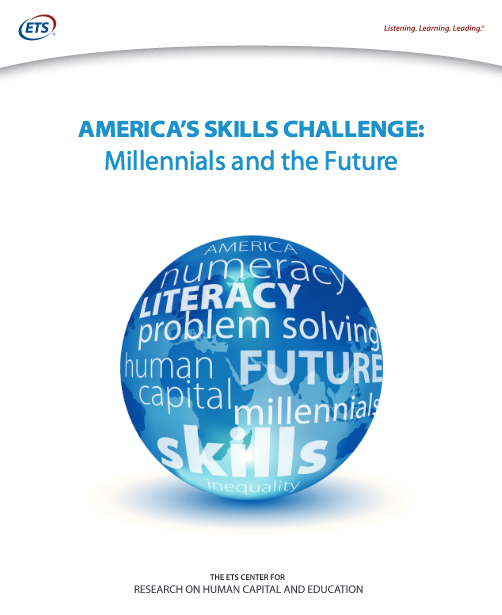
Another study released in 2015 should justify concerns about the news literacy of the current and coming digital generations: “America’s Skills Challenge: Millennials and the Future,” published by the Educational Testing Service’s Center for Research on Human Capital and Education. It found that young adults in the United States fall short of Millennials in other developed countries when it comes to the skills employers want most: literacy, practical math, and problem-solving in technology-rich environments. The study also found that the U.S. Millennials lagged behind other age groups within America itself. This is in a context in which 43 percent of Americans have earned college degrees, and 90 percent of Millennials now own a smartphone.

Equally troubling is that these findings represent a decrease in literacy and numeracy skills for U.S. adults when compared with results from previous adult surveys… In literacy, U.S. Millennials scored lower than 15 of the 22 participating countries. Only Millennials in Spain and Italy had lower scores.

The ETS study defined literacy as “the ability to understand, evaluate, use, and engage with written text to participate in society, to achieve one’s goals, and to develop one’s knowledge and potential.”

—Scott MacLeod

Glamour of Blogging

Journalists, take note.

Blair Eadie is one of the most successful bloggers out there. She blogs about fashion at Atlantic–Pacific. Her blog consists solely of photos of herself wearing different fashion outfits on locations mainly in New York. But she is connecting with people on the web, a goal that journalists need to think much more about: Atlantic–Pacific is getting some 2 million page views per month.

blog-fashionblogging

You wouldn’t call what Eadie does journalism—fashion bloggers typically make their money through sponsorship, paid collaborations, and hosting links to retail products, so their work is akin to marketing or public relations. In fact, Eadie got into blogging while working as a merchandiser for Gap in San Francisco and witnessing how bloggers were influencing fashion lines. A challenge for journalists in the online age is to find business models to achieve what Eadie is managing to do—while strictly maintaining journalistic independence.

Blogging isn’t as glamorous as it looks, even for branded fashion bloggers like Eadie. Researchers Brooke Erin Duffy and Emily Hund have a report in the latest issue of Social Media+Society about this titled “‘Having it All’ on Social Media: Entrepreneurial Femininity and Self-Branding Among Fashion Bloggers.” (They summarize the report in an Atlantic piece here).

The bloggers we interviewed unanimously described their work as more than a typical full-time job; many estimated they devoted more than 80 hours a week to their blogs and related activities. Others shared how they were up into the wee hours responding to commenters, crafting posts, and editing images to fit the technical and strategic requirements of various platforms.

—Scott MacLeod

French Press: Mon Dieu!

France’s crise de la presse has no end in sight. Like almost everywhere, France’s print newspapers are grappling with declining sales, slumping ad revenues, and the challenges posed by digital media—how to join the digital revolution, or be crushed by it.

WWD has an interview with Francis Morel, CEO of France’s Les Echo Group, that gives a glimpse into the boardroom forces driving change in the French media. Among those forces: the takeover of French newspapers by conglomerates with no experience in journalism or professional stake in a free press; a trend toward boutique products like weekend magazines to attract elite readers and advertisers who want to reach them; and a determination to exploit marquee newspaper brands to develop consulting units and other sidelines.

morel-photo

Morel reports that such services could soon represent almost half of the business at Les Echos, which began publishing as France’s first daily financial newspaper in 1908:

There are always activities to develop to complement the main business of media. We launched Les Echos Solutions in June with services ranging from crowdfunding to market studies and incubators for start-up companies. We are developing a publishing arm for companies with a separate staff. Services will represent one-third of the group sales in 2016. Down the road, they could be up to 45 percent of Les Echos’ business. We define ourselves as “the first media outlet for information and services,” which makes us stand out. On the services front, I think we are at the forefront.

Les Echos is just another case of how French journalists find themselves entwined with conglomerates. The paper was closely held by the Schreiber family and then the Beytout family for eight decades before being sold to Britain’s Pearson PLC, itself a publishing and education company. In 2007, Pearson sold it to LVMH, the French luxury goods conglomerate focused on brands like Louis Vuitton, Christian Dior, and Moët & Chandon. Under Morel, Les Echos Group is now about to take ownership of two more French dailies, Le Parisien and its national counterpart, Aujourd’hui en France. That will put Les Echos Group in the top rank of French mainstream press, along with Le Monde and Le Figaro.

The marriage of journalists and conglomerates has not been a happy one. Shortly after the LVMH acquisition of Les Echos, editor Erik Israelewicz resigned over alleged editorial interference, and his staff went on strike to insist on editorial independence. Similar tensions arose in 2010 when a trio of French tycoons took control of Le Monde: Matthieu Pigasse, Pierre Bergé, and Xavier Niel. Since then, the paper has gone through five chief editors. (The trio, meanwhile, has acquired Le Nouvel Observateur, now simply L’Obs, a leading French newsweekly). Le Figaro, another French newspaper of record, is owned by the Dassault Group, known for its aerospace business in Mirage fighter bombers and other military aircraft.

libe

Critics accuse the French (and their labor unions) of being resistant to change. Where independent journalism is at stake, that may not be a bad thing at all. Last year journalists at Libération went on strike against a plan by its shareholders led by chairman Édouard de Rothschild (38.6 percent share) to “save” the paper—besides the usual staff cutbacks, the plan would turn the newspaper’s headquarters into a cultural center and reinvent the paper itself as a social network. Journalists at Libération, which was founded by philosopher Jean-Paul Sartre after the 1968 student and worker upheavals in France, explained their walkout with the front-page headline:

WE ARE A NEWSPAPER not a restaurant, not social media, not a TV studio, not a bar, not a startup incubator…

—Scott MacLeod