
media chinwag

Musings on Journalism in the Online Age

Month: November, 2015

Covering the Hate Beat

A notable feature of the 2016 race for the White House has been the free flowing comments of some Republican candidates against economic migrants and political refugees and, by association, against the Latino and Muslim communities. The comments go beyond anti-immigration rhetoric and cross the line into the realm of hate speech.
hatespeech

Businessman Donald Trump led the way in his presidential announcement speech on June 16 by describing Mexican immigrants as criminals, drug smugglers, and rapists. After the terrorist attacks in Paris on November 13, he redirected his venom toward Muslims. He called for a database to monitor Syrian refugees and possibly all American Muslims as well. Trump accompanied this view with a statement questioning the loyalty of American Muslims, claiming that immediately after the September 11 terrorist attack on Manhattan’s World Trade Center “thousands and thousands of people were cheering” across the river in Jersey City “where you have large Arab populations.”

Trump’s Islam-bashing actually started long before he became the leading contender for the Republican presidential nomination—he’s been at the top of the polls since June. He was one of the loudest voices in the United States pushing right-wing claims intended to smear President Barack Obama—that he was born in Kenya—which would disqualify him from occupying the presidency—and that he was a secret Muslim.

Ben Carson, an African-American neurosurgeon in the Republican race, chimed in that Muslims are unfit to be president of the United States because of their religious faith. Ted Cruz, a senator from Texas and another Republican candidate, called for banning refugees from Syria if they are Muslim, but letting Christians in. “There is no meaningful risk of Christians committing acts of terror,” he explained. Another contender, Senator Marco Rubio of Florida, echoed a threat by Trump to shut down U.S. mosques as venues inspiring radicalism. In the latest opinion survey, Trump, Rubio, Cruz, and Carson lead the Republican race with 36, 14, 12, and 10 percent support, respectively, among likely Republican primary voters.

To a great extent, American mainstream news media organizations, wittingly or otherwise, have propelled the hate speech. They have hyped the sound bites, replaying them in headline after headline and broadcast after broadcast, to the point that the comments have enabled the candidates to drive news coverage and thus dominate the campaign discourse. Moreover, too rarely are the comments characterized as hate speech, but are rather labeled as “controversial” or “provocative.” Here journalists are pursuing a false objectivity, eager to prove they are not biased for or against any candidate or party. They are also taking refuge in a false equivalency that treats comments defending or attacking Latino or Muslim communities as equally valid and acceptable political discourse.

Hate speech is broadly protected by the First Amendment, giving Trump and the other Republican candidates a constitutional right to make their odious comments. In Europe, they would need to be more careful. Britain’s Racial and Religious Hatred Act of 2006 makes it an offense to incite hatred against a group of people based on their religious beliefs. In France, even an icon such as Brigitte Bardot has been convicted and fined for inciting hatred with anti-Muslim comments, including: “My country, France, my homeland, my land is again invaded by an overpopulation of foreigners, especially Muslims.”

Nor in the United States is the right of free speech absolute. Incitement of violence, for example, is not fully protected—and there are reasons to believe that Trump’s remarks have incited violence. The cartoons mocking the Prophet Mohammed published by the Danish newspaper Jyllands-Posten became a cause célèbre for many free speech advocates, who argued that by definition free expression must include the right to spout offensive ideas. (The cartoons most certainly were a direct cause of the anti-Danish protests and riots that swept the Islamic World afterwards, with some 200 deaths.) In an aggressive campaign asserting such a right, the French satirical weekly Charlie Hebdo famously persisted in publishing insulting cartoons of the Prophet Mohammed. When Muslim extremists attacked the magazine’s offices and slaughtered 12 people last January, massive demonstrations erupted across France proclaiming “Je Suis Charlie,” ostensibly in defense of free speech.

These can be difficult issues, certainly for journalists, who see part of their calling as a mission to defend the right to a free press. Nobody should argue that the news media should ignore hate speech, least of all when it is spewed forth by public figures and even aspirants to the presidency. The question is how to cover it.

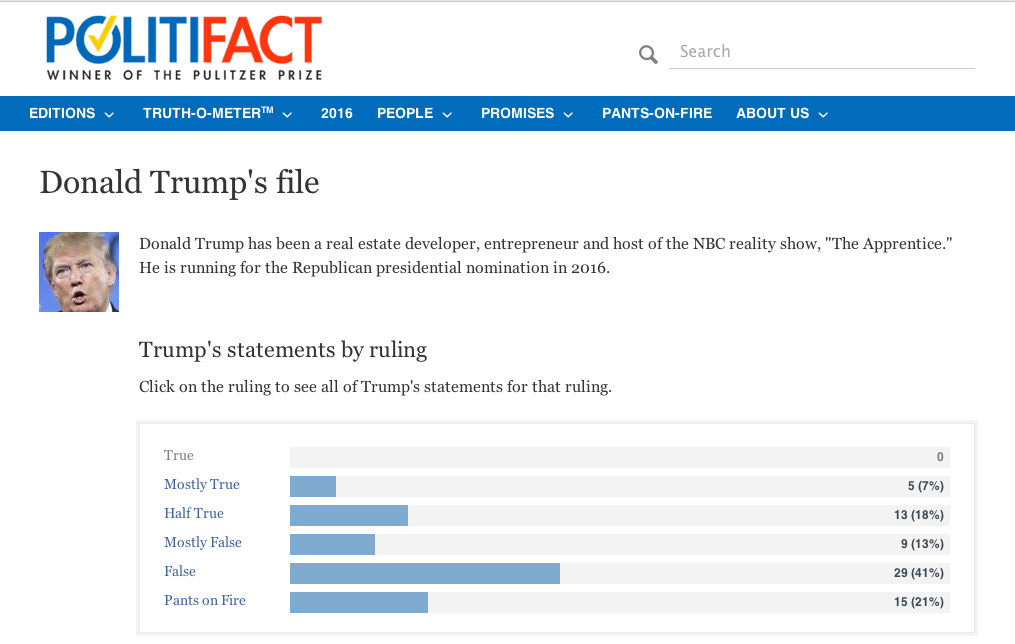
When journalists cover criticism of the hate-mongers, they provide readers and viewers with important alternative viewpoints. News media outlets have traditionally called out lies or provided context on their editorial and Op-Ed pages. Some news media and civil society organizations have institutionalized platforms that make fact checking a discrete service holding public figures accountable for the accuracy of their statements. The Washington Post, FactCheck.org, and PolitFact.com have done admirable work in exposing Trump’s untruths about Latinos and Muslims. In September, the New York Times carried a strongly worded editorial criticizing the Republican attack on Muslims.

But this is not enough, not in an era when the best intentions of the finest journalists are often drowned out by the deafening idiocy of “debates” on so many cable and satellite so-called news channels, or otherwise overwhelmed by social media chatter.

News executives and beat journalists alike need to take a long, hard look at how to define and treat hate speech in the digital media age. One of the principles of journalism is pursuit of the truth—and “truth” is not just dutifully recording and endlessly repeating the hate speech of politicians, but also providing background and perspective. Journalists have an important obligation to their societies to be responsible framers of the public discussion—but this is not accomplished when the endless repetition of the hateful sound bites overwhelms the few stories or editorials here and there that attempt to give critical context.

Broadly speaking, the American mainstream news media has failed miserably in its obligation to provide a comprehensive and proportional narrative of American life—including the lives and voices of ethnic and religious minorities. It should go without saying that Latino and Muslim communities and new immigrants—including the undocumented immigrants that Republicans are so fond of baiting—have made enormous positive contributions to the economic and cultural vitality of the United States. America, indeed, is a nation of immigrants. Yet, pack journalism’s obsession with sound bytes and easy headlines reinforces ignorance about minority communities and the issues around them.

There are a number of immediate steps that American editors and reporters can take to address hate speech. They can put the brakes on automatic, continuous, tabloid-style coverage that treats a politician spewing hate speech as if it was just Justin Bieber committing another act of adolescent mischief. Instead, they can provide their readers and viewers with thoughtful explorations and discussions that use universal human values, rather than the false objectivity and balance supposedly conferred by equal column inches and air time, as journalism’s frame of reference. American journalists can devote space to much fuller, more responsible coverage of communities upon which demagogues are apt to prey.

At the heart of the matter is the philosophical question of free speech. Without any hesitation, it should be practiced and defended at all costs. Whether one cites Supreme Court decisions or the law of common sense, it is clear that healthy societies are built upon the free flow of information and opinions. That is precisely why it is so important that journalists not abuse their right of free speech, or enable others to abuse it. Journalists need not scapegoat, defame, or humiliate our most vulnerable communities, or provide the megaphone for those who do, to prove that free speech is a value worth defending.

—Scott MacLeod
NYT: “Our Path Forward”

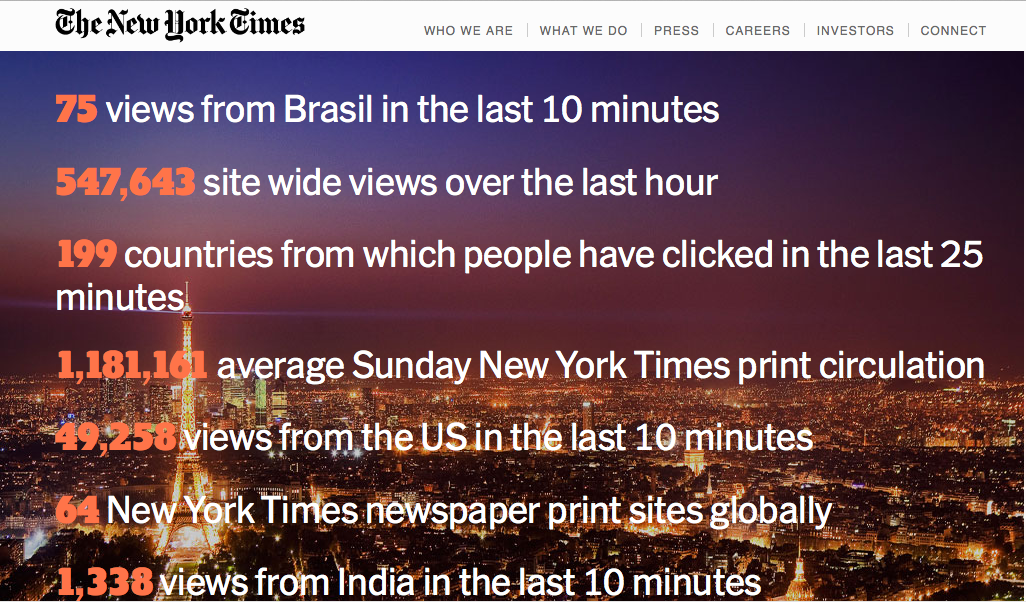
Its 96-page internal “Innovation” report in March 2014 called for a strategy to make the New York Times newsroom “a truly digital-first organization.” Last month, the strategy was unveiled, and it might rather be termed a “mobile-first” strategy.

Screen

Executive Editor Dean Baquet, Chairman and Publisher Arthur O. Sultzberger Jr., and eight other officials of the 164-year-old newspaper company declared in an 11-page memo solemnly titled “Our Path Forward”: “Our company was built for the print era and now must be redesigned for the mobile era… Our first two million subscribers grew up with The New York Times spread out over their kitchen tables. The next million must be fought for and won over with The Times on their phones.”

The memo noted that in the last five years, the newspaper has doubled its digital revenues to $400 million. The headline from the memo was a goal to double the digital revenues again to $800 million by 2020. Last summer, the Times announced that it had surpassed the 1 million mark in digital subscribers.

The Times is making an impressive effort to figure out how a major news organization rooted in the print era can survive in the digital era. With so much at stake—the Times‘ epic contribution to American journalism, the legacy of a great newspaper family—one assumes this strategy is as cutting edge as it gets. But will it work?

The Times is betting on its uniqueness. It is betting that the best business model should focus on getting users to pay for Times journalism—on the basis of the uniquely high quality product it offers—rather than depending on advertising revenues.  The Times is betting on digital subscriptions, and it believes that loyalty of digital subscribers is what will drive whatever digital advertising it also manages to attract.

From the memo:

Though “user-­first” has become a popular buzz phrase in recent years, it has real meaning for us. While most of our competitors chase scale, our unique business model is built on directly asking our most loyal readers to help us pay for our massive news gathering operation.  In addition to contributing all of our digital subscription revenue, they also are responsible for driving the majority of our advertising revenue  through their deep engagement. The sustainable path to long-­term revenue growth requires that we always prioritize user experience and  the needs of our customers over hitting quarterly revenue targets.  These deep reader relationships are our  most valuable  asset.

The Times newsroom, 1,300 journalists strong, has already re-geared as a digital-first organization. The memo accepts the “inevitable decline in print.” But the memo’s talk about the need to “deepen the engagement with our current readers” and “building new relationships with people around the world” is a leap of faith.

The Times has prioritized hiring journalists “with new skills in graphics, video, technology, design, data, audience engagement and much more.” In outlining fresh approaches for the digital era, the memo points to innovations like digital storytelling techniques, big multimedia projects, video reports, liveblogging, mobile phone alerts, newsletters, translations, service journalism, and new formats like Apple Watch and Snapchat. These are in line with the Times‘ core goal of making the user experience as enriching and personal as possible.

Yet, it’s not clear how those wonderful features produced by digital-savvy journalists are going to enable the Times to keep its 2 million current paying customers—one million of them buying the print paper—let alone recruit new ones. Undoubtedly news consumers everywhere will continue to love reading the Times. The question is whether enough of them will be willing to pay for it.

The memo predicts that “over the next few years, the battle is going to be won or lost on smart phones.” Yet, mobile devices with five-inch display screens don’t seem to be a very ideal platform to support what the memo rightly calls “ambitious, original, high-quality journalism that is essential for an informed society.”

In the last few financial reporting quarters, the Times has been clocking 20 percent or so increases in its digital subscribers—no doubt, one of the reasons for the surprising confidence expressed in “Our Path Forward.”

Other numbers continue to be sobering, however. Digital advertising revenues, though steadily improving across the industry, only contribute about one-third to overall ad revenues. Print ad revenues have been steadily declining at the Times in 2015—down 11 percent in the first quarter, 13 percent in the second quarter, and about 1 percent in the third quarter. In the third-quarter results released at the end of October, just three weeks after the “Our Path Forward” memo was issued, even digital ad revenues declined by 5 percent. As the memo says, “for all we’ve accomplished, our digital business is not yet close to supporting the scale of our ambitions.”

The Times’ strategy is a clear-headed appraisal of the challenges it faces, and a reasonable action plan for survival in the digital era. It aims to not only survive but thrive. The Times‘ goal is nothing less than attracting readers who will “build a lifetime relationship with The New York Times.” Times‘ executives deserve enormous credit for their unyielding commitment to quality journalism rather than bottom lines. Yet the Times‘ future depends to a great extent on dynamics outside its control.

The memo notes, for example, that the Times will particularly focus on younger readers, who are “reliable first indicators of major trends that ultimate affect our entire audience.” Already the under-35s make up 40 percent of the Times’ mobile audience. But studies show that these so-called Millennials have adopted digital media consumption habits for the digital age—digital natives are getting their news from networks such as social media more than via destination news sites. It is far from certain that the Times will be able to demonstrate to this demographic “the unique value of consuming The Times on our own platforms.” The memo acknowledges the ominous phenomenon of readers’ “changing habits.”

As the memo notes:

Skeptics still openly wonder if we can continue to deliver on this journalistic mission, given the seeming mismatch between the economics of news media and the scale of our operations. They suggest the days when a media company can fund a big, ambitious  newsroom are over. They doubt we can continue to cut legacy costs and fund digital innovation at the same time.

These are serious and fair questions. The most pressing challenge is not to prove that our journalism matters—it’s to demonstrate that our business can continue to support this mission.

—Scott MacLeod

Catalyst Chicago: Small Is Beautiful

With Old Media disrupted, and New Media overwhelming us with dating advice columns and kitty videos, how wonderful it is to see a non-profit like Catalyst Chicago celebrating 25 years in business. Founder-editor-publisher Linda Lenz launched the publication in 1990 to provide extensive coverage of Chicago Public Schools. Catalyst has been an exemplar of community journalism since the print age, and it is also a model representing the possibilities of journalism in the online age.

cat-1cat-25

Lenz’s story of Catalyst’s origins, which she relates in a 25th anniversary issue, sounds like good strategy for an online start-up:

My idea for Catalyst Chicago began with the Chicago School Reform Act of 1988, which cracked open and breathed new life into a calcified school district. The key feature was revolutionary: creating elected local school councils—six parents, two community members and two teachers—that would have the power to select their schools’ principals, a make-or-break decision for schools regardless of who does the choosing.

That structure created a need, I thought, for an independent source of in-depth information on education issues so that council members and others newly involved in the system could knowledgeably participate in this grand experiment in local control.

For the previous decade, I had been the education reporter for the Chicago Sun-Times, and I knew that the news media would not have the time, space—we were still a print world—or inclination to dig deep into school-improvement issues on a regular basis.

Creating an editorial plan was easy, but I didn’t know how to put it into motion, so I consulted a savvy news source, Anne Hallett, who was then executive director of the Wieboldt Foundation. Anne said: “Go talk to the Community Renewal Society,” which at that time had been publishing The Chicago Reporter, an investigative newsletter focused on race and poverty, for 17 years.

At CRS I reunited with Roy Larson, the Reporter’s editor and publisher, who had been the religion editor at the Sun-Times and my pod-mate. Roy melded my idea with CRS’s idea for a newsletter for parents, and together we went in search of funding. As it turned out, the MacArthur and Joyce foundations had been looking for a way to track implementation of the Reform Act, and The Chicago Community Trust was interested in assisting parents.

So in February 1990, the first issue of Catalyst rolled off the presses. Reviewing our early issues—and they are all online—I am struck by how little the major issues have changed. In our first few years, we reported on principal selection, testing, school choice, the shortage of bilingual teachers, funding equity and overcrowding in Hispanic communities.

Catalyst is published by but is editorially independent from the Community Renewal Society, a civic group founded in 1882 whose mission statement calls public engagement one of four primary components of a theory of change:

For citizens or organizations to take action on an issue, they must first be aware of the issue and its importance and understand its causes, its consequences and possible solutions to it. Effective public engagement is intertwined with building knowledge and understanding. Community Renewal Society’s newsmagazines—Catalyst Chicago and The Chicago Reporter—will surface issues and provide insightful analyses into pressing social concerns.

Catalyst, today an online publication that has reduced its newsmagazine run from nine to three issues per year, has gone on to do solid reporting on every imaginable issue confronting Chicago public education. It has won some 50 prizes for its reporting, including a Studs Terkel Community Media Award in 2011. In the last few years Catalyst’s coverage has included in-depth reports on the shortage of funds for sports facilities, the challenges high school graduates face in completing college, drugs in schools, and teacher turnover.

In October, a 2013 story by Catalyst reporter Sarah Karp on a $20 million no-bid professional development contract to train school principals yielded spectacular results: the federal indictment of former Chicago Public Schools CEO Barbara Byrd-Bennett on charges of funneling contracts to former employers in exchange for kickbacks; within days, Byrd-Bennett pleaded guilty to one count of fraud in the bribery and kickback scandal, and agreed to cooperate on further cases.

Karp’s story had pointed out that Byrd-Bennett had worked for the company receiving the no-bid contract immediately prior to joining Chicago Public Schools, initially as a consultant. Karp’s reporting intrigued the school system’s inspector general, and soon federal prosecutors were on the case. The fact that it was a community publication that broke the scandal, and not the major Chicago media players like the Tribune and the Sun-Times, is testimony to the critical importance of community journalism.

As Lenz told the Columbia Journalism Review: “What we do is give our staff the gift that most journalists want, which is time. Our journalists have time to go through reports. They become really expert on the nitty-gritty, how a school system works. And then they have the time to go after things.”

How does Catalyst manage to pay its great journalists? Its longtime business model is one that more and more media organizations are starting to consider. It is funded by print and online advertising, contributions from individuals, and grants from companies and foundations including: the Boeing Company, The Chicago Community Trust, Lloyd A. Fry Foundation, John S. and James L. Knight Foundation, Robert R. McCormick Foundation, McDougal Family Foundation, Oppenheimer Family Foundation, Polk Bros. Foundation, Spencer Foundation and the Voqal Fund.

—Scott MacLeod