Adversarial muckrakers + civic-minded billionaire = a whole new world
That was the sub-headline on a Columbia Journalism Review article on October 17, 2013. It perfectly summed up the excitement many of us felt about the announcement that billionaire eBay founder Pierre Omidyar and national security journalist Glenn Greenwald were getting into the journalism business together. But, alas, the partnership still seems to be very far from reaching its objectives and potential.

By February 2014, Omidyar and Greenwald, with a barebones staff, had launched The Intercept. According to its mission statement, The Intercept is “dedicated to producing fearless, adversarial journalism. We believe journalism should bring transparency and accountability to powerful governmental and corporate institutions, and our journalists have the editorial freedom and legal support to pursue this mission.”
Over the past two years, The Intercept has undoubtedly proved to be an important new player in American journalism. It has hired stellar journalists such as—in addition to Greenwald—Laura Poitras, Jeremy Scahill, and Peter Maass. It has been a relentless watchdog on powerful people and institutions, initially as a platform for Greenwald’s ground-breaking reporting on the National Security Agency based on leaked documents from Edward Snowden.
Yet, by The Intercept’s own reckoning, the launch of the publication was severely hampered by the management style of First Look Media, the parent company Omidyar created for an envisioned $250 million investment in journalistic projects.
In June 2014, Greenwald, Poitras, Scahill and Matt Taibbi—who was hired to start a separate First Look Media publication called Racket—wrote a letter to Omidyar complaining that budgetary and personnel restrictions were jeopardizing the whole enterprise. The Intercept, already up and running with big-name journalists, managed to work out some of the kinks with First Look. But Taibbi left the company to return to Rolling Stone magazine, and First Look shut down Racket before its launch.
The recent scandal involving reporter Juan Thompson indicates that The Intercept’s organizational problems are far from over. And these problems are beginning to infect The Intercept’s credibility.
In “A Note to Readers” on February 2, 2016, Editor in Chief Betsy Reed announced the firing of Thompson, who had covered race and criminal justice issues for The Intercept since November 2014. An internal investigation had revealed that Thompson fabricated quotes, deceived editors, and lied about his reporting methods.
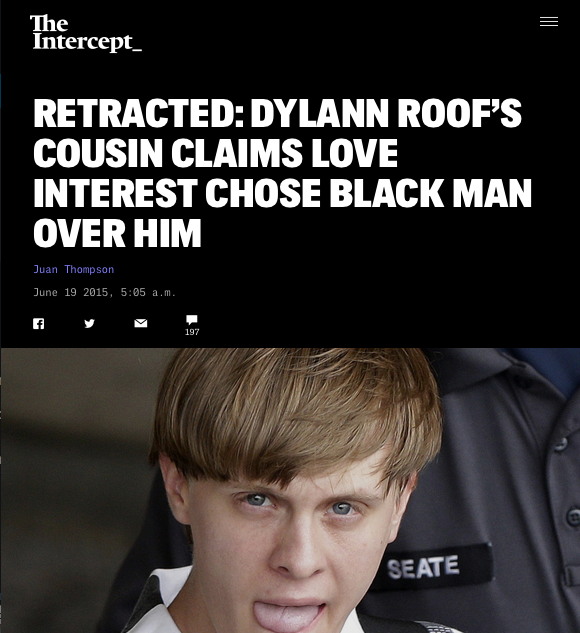
One of the egregious examples was a Thompson story dated June 19, 2015, about 21-year-old Dylann Roof, who slaughtered nine African Americans in a church in Charleston, South Carolina two days earlier. The article quoted Scott Roof, who was identified as Roof’s cousin, saying that Roof went “over the edge” when a girl he liked started dating an African American man. The Intercept’s internal investigation, which included speaking with two members of the Roof family, said the family did not know of such a cousin.
In her note, Reed accepted responsibility for the Thompson affair, apologizing to the subjects of the stories, to people who were falsely quoted, and to The Intercept’s readers. “The best way we can see to maintain the trust of readers,” she wrote, “is to acknowledge and correct these mistakes, and to focus on producing journalism we are proud of.”
That may not be enough to maintain the trust of The Intercept’s readers. The Thompson fabrications amount to an institutional scandal of great proportions, particularly for an organization that prides itself on reporting highly sensitive stories based on anonymous sources.
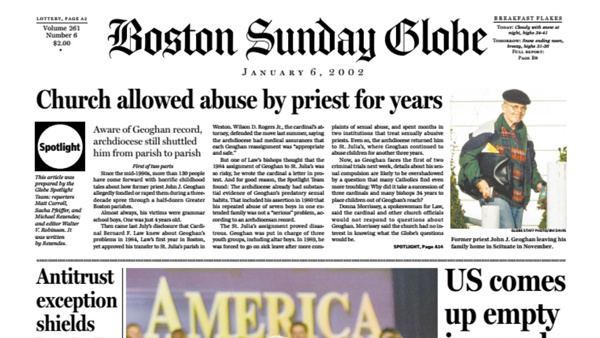
The Intercept should follow through with a full (and preferably independent) investigation into Thompson’s career and work at the publication. The review should not only cover Thompson’s reporting methods and deceptions, but the editorial process that enabled him to get away with the fabrications. Precedents for such accountability have been set by other publications, notably the New York Times in the Jayson Blair scandal, and Rolling Stone in the case of its discredited story about a vicious gang rape at a college fraternity house.
Also curious is The Intercept’s decision to keep Thompson’s 40-some stories for the publication as well as his biography on its website. The Dylann Roof story is labeled “Retracted” with an editor’s note explaining why, and four other stories are labeled “Corrected” with similar editor’s notes.
However well intended, this approach does nothing to restore the breach of trust that The Intercept has created with its readers. It leaves the impression that everything is more or less okay, except for a few errors here and there by a lone reporter that have now been “corrected.” It leaves the mea culpa seeming half-hearted.
Perhaps a better idea is for The Intercept’s homepage to display a prominent hyperlinked “Correcting the Record” box, where readers would be taken to a full report on the affair and an account of measures being taken to prevent future breakdowns in the editorial process.
If Thompson’s bio is to remain, it should be accompanied by text clearly explaining his role in the breach of trust. His journalism should be transparently removed from the website, or kept in a special section devoted entirely to the scandal. Readers can hardly have any confidence in his articles after his own editor in chief stated that “Thompson went to great lengths to deceive his editors, creating an email account to impersonate a source and lying about his reporting methods.”
After all its organizational problems, New Look Media is well advised to get its act together. This is an outfit that was flung together too quickly, without regard for the importance of creating a foundational institutional culture suited to the work of journalism. Omidyar formed the partnership with Greenwald within a few weeks of meeting him for the first time, without even discussing roles and responsibilities. Omidyar’s idea resembled what New York University’s Jay Rosen calls the “personal franchise model” of assembling star journalists and supporting them.
The Intercept itself diagnosed the problem with this idea, in a remarkable article it published in October 30, 2014 about the turmoil within First Look Media that led to Matt Taibbi’s exit:
First Look and the editorial staff it hired quickly learned that it is much easier to talk about such high-minded, abstract principles than it is to construct an organization around them. The decision to create a new editorial model left space for confusion, differing perspectives, and misaligned expectations.
—Scott MacLeod


 media chinwag