media chinwag

Musings on Journalism in the Online Age

Category: Arab media

A Tribute to Éric Rouleau (1926–2015)

Éric Rouleau had a deep relationship with Egypt and the Middle East—he was Le Monde’s correspondent in the region for 30 years, and later served as France’s ambassador to Tunisia and to Turkey. He was born in Cairo, began his journalism career on the Egyptian Gazette, and maintained a lifelong attachment to his native country.

A tribute to Éric will be held in Cairo on October 13 on the occasion of the Arabic translation of Éric’s final work, Dans les coulisses du Proche-Orient: Mémoires d’un journaliste diplomate (1952-2012). The event is hosted by American University in Cairo’s Middle East Studies Center, the Institut Francais d’Egypte, and the Al-Tanany Publishing House.

eric

One of the speakers is longtime Le Monde Diplomatique Editor-in-Chief Alain Gresh, who wrote a poignant appreciation of Éric’s life and career in Orient XXI last March. A translation appears in the Cairo Review of Global Affairs. Here’s a brief excerpt:

In 1985, Rouleau transitioned to a diplomatic career at the request of President Mitterand. He was appointed ambassador, first to Tunis—then headquarters of the Arab League, and the city where the Palestinian Liberation Organization sought refuge after its expulsion from Beirut in 1982—and later to Ankara. After this time, only diplomats would benefit from his culture, analyses, and countless connections. Ironically, Rouleau himself noticed that the number of his readers dropped from hundreds to two, and even sometimes one—the president of the Republic.

During the first meeting of French ambassadors held in Paris after his appointment, each of the diplomats introduced themselves and their country of assignment—for example the Ivory Coast, Jordan, Argentina, etc. When it was his turn, he stood up and said: “Éric Rouleau, Le Monde.” There was silence, then the audience broke into laughter. Freud believed that slips of the tongue expressed unconscious desires. Did Rouleau consider himself the ambassador of the daily newspaper? Or did he see himself as ambassador to the world, monde in French, as he crossed from north to south? Or, might he have simply meant that he was our ambassador to a planet whose glitches he would help us solve?

Also, read “Cairo: A Memoir,” by Éric Rouleau in the Summer 2012 edition of the Cairo Review.

5029_MESC-Eric Rouleau-2-Sep2015_1

“A Tribute to Éric Rouleau (1926–2015)” will be held in Oriental Hall, AUC Tahrir Campus, from 6 p.m. to 8:30 p.m. on Tuesday October 13.

—Scott MacLeod


The Press, the Public, and the President

Leslie T. Chang has a good report in NYR Daily titled “Egypt’s Media: Endorsing Repression.” She writes on how journalists, perhaps notably the country’s influential political talk show hosts, are making energetic efforts to build a consensus behind the policies of President Abdel Fattah El-Sisi. It seems to be helping: the leader’s approval rating after a year in office was around 90 percent.

Abroad, the Sisi administration is criticized for allowing more than a thousand people thought to be sympathetic to Morsi to be sentenced to death in mass trials; in Egypt, newspaper columnists say they should be executed without trial. Journalists occasionally criticize government performance on issues like education, health care, or religious policy. But as I discovered in interviews with leading talk show hosts and editors, they regard the defining feature of Sisi’s administration—the use of state-sanctioned violence and politicized trials to maintain order and crush its opponents—with near-unanimous approval.

media control

Chang reports on El-Sisi’s moves to influence the media, holding monthly meetings with editors and presenters, and telling television hosts they are responsible “for promoting unity and raising morale.”

As Chang notes, it’s not simply an issue of control from above. Egyptian journalists, especially those working for the independent media, were increasingly free to report during the last years of the Hosni Mubarak era—criticism of the president and even his family was tolerated. Journalists briefly became more assertive in their watchdog role after the January 25, 2011 uprising that ended Mubarak’s 30-year rule. In one of the most celebrated examples, Ahmed Shafik, an interim prime minister, abruptly resigned from office after being aggressively questioned on Baladna bel Masry, a political talk show on ONTV hosted by Reem Magued.

But the Egyptian public mood has become deeply fearful of instability, due to the polarizing presidency of the Muslim Brotherhood’s Mohammed Morsi, the protests and violence involved in his removal from office, the rise of jihadist chaos throughout the Arab word including in Egypt, and the nosedive of the Egyptian economy. El-Sisi is seen by millions as the nation’s protector—and only hope. Many journalists share the fears, or at least are influenced by the public’s intolerance for any further destabilization of the state. (The logic was no doubt at play last week in the Egyptian government’s ban on media coverage of the Egyptian military’s lethal attack on suspected insurgents who turned out to be Mexican tourists—few Egyptians want to see their army’s honor besmirched.)

Chang concludes:

In the two years since the army removed Morsi after huge demonstrations against him, the mainstream media has lost most of the openness it briefly enjoyed. Especially during major political events, the press speaks in one voice; journalists who break ranks sometimes find themselves vilified—not by the government but by their own colleagues and the public.

Egypt’s revolution taught the world that the power of a dictator can dissolve in an instant. But the lesson of the years since may be that, in a country threatened by chaos and violence, authoritarianism can hold a powerful appeal of its own.

—Scott MacLeod

The Scoop on HuffPost Arabi

huffpostarabi

HuffPost Arabi is off to a surprisingly rocky start. There was a good rundown of the problems recently on Brian Whitaker’s Al-Bab blog:

DIDN’T Arianna Huffington realise what she was getting into when she decided to launch HuffPost Arabi? In the first three weeks it has certainly been attracting attention, but mostly of the wrong sort.

The new Arabic-language website was born amid a show of bravado from Ms Huffington. Avoiding “any kind of censorship and control,” she said, would be “absolutely key”. For that reason it would be operating from London and Istanbul rather than any of the Arab countries, and would pursue stories “relentlessly”.

She also vowed to back the website’s writers to the hilt. “We will support [contributors] in every way,” she said. “Anyone persecuted for opinions published on the site” would be given legal funding and “extensive coverage” across other sections of Huffington Post.

But promising that kind of blanket support to largely unknown writers for as-yet-unwritten articles was inviting trouble – especially considering that the editorial director of Huffington Post’s Arabic offshoot is a Qatari known for his pro-Islamist stance and its Egyptian editor-in-chief is a self-declared member of the Muslim Brotherhood.

Read Whitaker’s entire article here. Among the problems he cites: an article by an Egyptian writer that castigated gays that Huffpost Arabi found it necessary to delete; a rosy tribute to the late Taliban leader Mullah Omar by the former Al Jazeera correspondent in Afghanistan; and an essay by an Algerian researcher denouncing selfie photographs as “sick.”

This is what the Independent had to say when HuffPost Arabi launched in July. Check out Arianna Huffington’s launch announcement.

Huffington spoke about HuffPost Arabi and her ever expanding international reach in an interview with me for the Cairo Review of Global Affairs Winter 2015 edition.

—Scott MacLeod

Reporting from Egypt

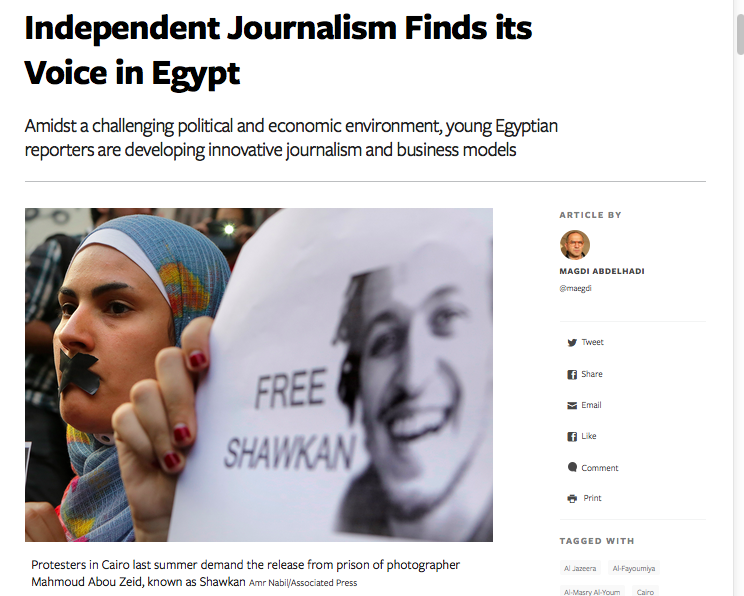
Magdi Abdelhadi has a nice piece in Nieman Reports about the struggles of independent media in Egypt. Among other things it highlights the work of Mada Masr and its editor, Lina Attalah (American University in Cairo ’04):

In 2013, Lina Attallah and her colleagues lost their jobs at Egypt Independent, the English-language edition of the flagship daily, Al-Masry Al-Youm. After a dispiriting series of editorial and financial disputes with their bosses, Attallah and her colleagues decided to start Mada Masr (“Egypt’s Horizon”), an English-Arabic news and arts website that caters primarily to Egypt’s well-educated cultural elite, rather than look for jobs at other mainstream outlets. “There was nowhere else to work,” says Attallah. “It was a time when media freedom became more and more limited. No media outlet could afford to hire independent journalists who wouldn’t compromise the content. And that is why we had to build our own space.”

egyptindependent

Amir-Hussein Radjy profiled Mada Masr in the Summer 2015 edition of the Cairo Review of Global Affairs. Leslie T. Chang wrote an in-depth report on the organization in The Long Read section of the Guardian last January.

There are brave journalists out there doing the best work that can be done  in Egypt under present circumstances. In August, President Abdel Fattah El-Sisi signed a new counterterrorism law that, according to Human Rights Watch, “makes it a crime to publish or promote news about terrorism if it contradicts the Defense Ministry’s official statements and would allow the courts to temporarily ban journalists from practicing their profession for doing so.”

—Scott MacLeod