media chinwag

Musings on Journalism in the Online Age

Category: investigative journalism

Hollywood’s Spotlight on Journalism

Well, how ironic! Amid the ongoing collapse of newspaper journalism, a movie about newspaper journalists wins the big Oscar for the first time.

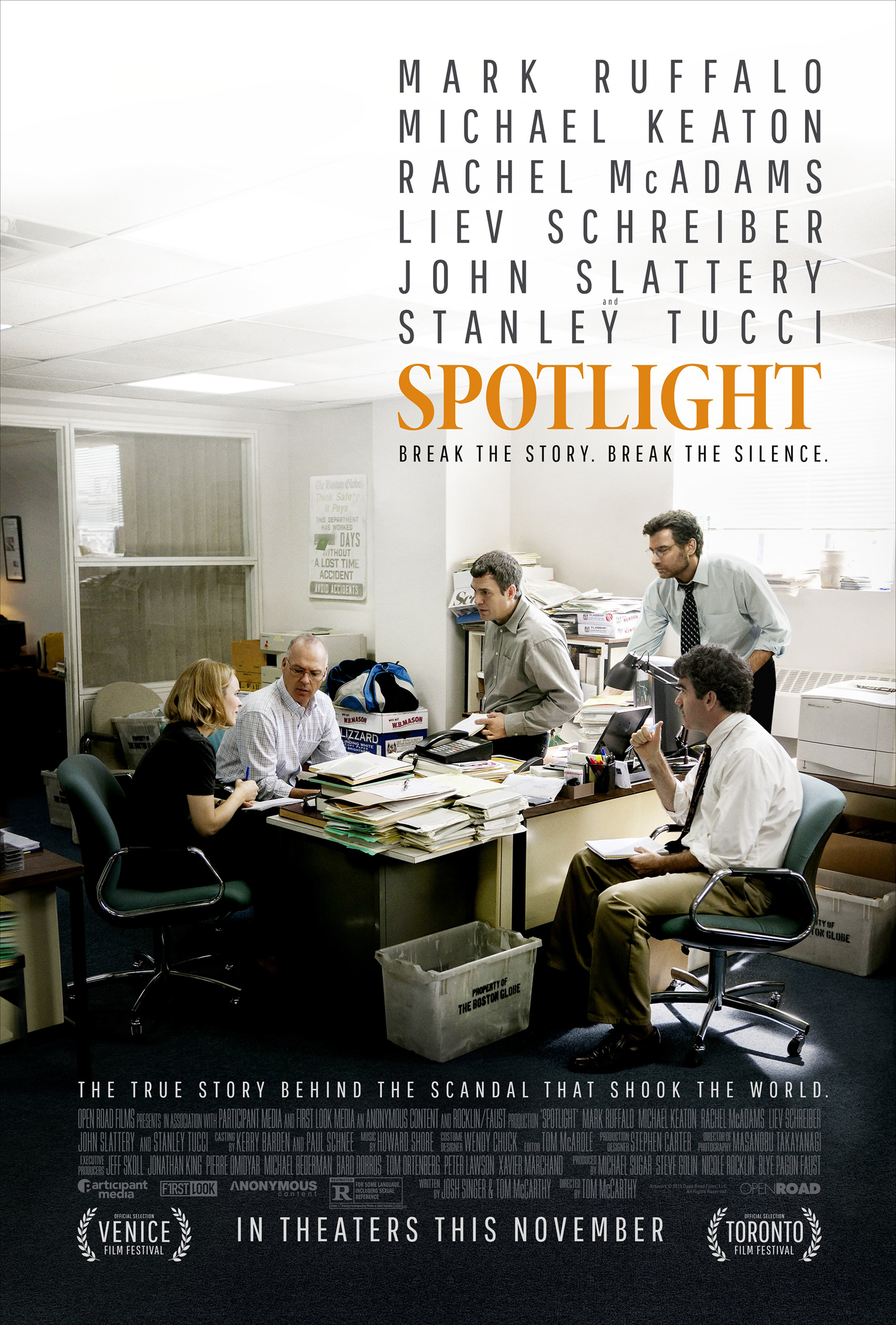
spotlight-poster

The 2015 Academy Award for Best Picture goes to Spotlight, which tells the true story of the Boston Globe Spotlight Team investigative reporting unit that revealed widespread child sex abuse by Roman Catholic priests and the cover-up of the crimes by high-level church officials.

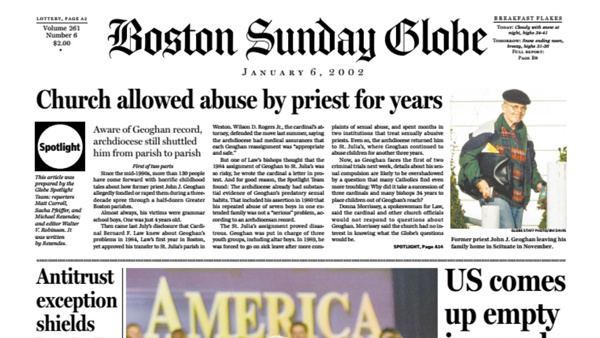
The Globe itself won the 2003 Pulitzer Prize for Public Service “for its courageous, comprehensive coverage of sexual abuse by priests, an effort that pierced secrecy, stirred local, national and international reaction and produced changes in the Roman Catholic Church.” The Globe’s Pulitzer entry included 22 stories, including the first piece in the series written by Michael Rezendes titled: “Church allowed abuse by priest for years: Aware of Geoghan record, archdiocese still shuttled him from parish to parish.”

boston-globe

Josh Singer, who along with Spotlight co-writer Tom McCarthy won the 2015 Academy Award for Best Original Screenplay, recently explained how the film’s underlying message is the importance of journalism to society:

This story isn’t about exposing the Catholic Church. We were not on some mission to rattle people’s faith. In fact, Tom came from a Catholic family. The motive was to tell the story accurately while showing the power of the newsroom—something that’s largely disappeared today. This story is important. Journalism is important, and there is a deeper message in the story.

I don’t think many understand the value of a good newsroom. The L.A. Times used to have 19 reporters covering legislature and now they have 4. When you have fewer reporters covering a story, you have far less accountability.

We wanted to spark or rekindle an interest in accurate and accountable journalism. When there is this kind of accountability among good journalists working together, it has a lasting affect on the public. Remember, Watergate was also a local story that became national.

Newspapers may be shrinking or dying, but investigative journalists are not giving up. In the Cairo Review of Global Affairs, Brant Houston reports on how non-profit news organizations are picking up some of the slack.

Here’s the Spotlight trailer


—Scott MacLeod

The Intercept, Two Years On

Adversarial muckrakers + civic-minded billionaire = a whole new world

That was the sub-headline on a Columbia Journalism Review article on October 17, 2013. It perfectly summed up the excitement many of us felt about the announcement that billionaire eBay founder Pierre Omidyar and national security journalist Glenn Greenwald were getting into the journalism business together. But, alas, the partnership still seems to be very far from reaching its objectives and potential.

intercept

By February 2014, Omidyar and Greenwald, with a barebones staff, had launched The Intercept. According to its mission statement, The Intercept is “dedicated to producing fearless, adversarial journalism. We believe journalism should bring transparency and accountability to powerful governmental and corporate institutions, and our journalists have the editorial freedom and legal support to pursue this mission.”

Over the past two years, The Intercept has undoubtedly proved to be an important new player in American journalism. It has hired stellar journalists such as—in addition to Greenwald—Laura Poitras, Jeremy Scahill, and Peter Maass. It has been a relentless watchdog on powerful people and institutions, initially as a platform for Greenwald’s ground-breaking reporting on the National Security Agency based on leaked documents from Edward Snowden.

Yet, by The Intercept’s own reckoning, the launch of the publication was severely hampered by the management style of First Look Media, the parent company Omidyar created for an envisioned $250 million investment in journalistic projects.

In June 2014, Greenwald, Poitras, Scahill and Matt Taibbi—who was hired to start a separate First Look Media publication called Racket—wrote a letter to Omidyar complaining that budgetary and personnel restrictions were jeopardizing the whole enterprise. The Intercept, already up and running with big-name journalists, managed to work out some of the kinks with First Look. But Taibbi left the company to return to Rolling Stone magazine, and First Look shut down Racket before its launch.

The recent scandal involving reporter Juan Thompson indicates that The Intercept’s organizational problems are far from over. And these problems are beginning to infect The Intercept’s credibility.

In “A Note to Readers” on February 2, 2016, Editor in Chief Betsy Reed announced the firing of Thompson, who had covered race and criminal justice issues for The Intercept since November 2014. An internal investigation had revealed that Thompson fabricated quotes, deceived editors, and lied about his reporting methods.

One of the egregious examples was a Thompson story dated June 19, 2015, about 21-year-old Dylann Roof, who slaughtered nine African Americans in a church in Charleston, South Carolina two days earlier. The article quoted Scott Roof, who was identified as Roof’s cousin, saying that Roof went “over the edge” when a girl he liked started dating an African American man. The Intercept’s internal investigation, which included speaking with two members of the Roof family, said the family did not know of such a cousin.

In her note, Reed accepted responsibility for the Thompson affair, apologizing to the subjects of the stories, to people who were falsely quoted, and to The Intercept’s readers. “The best way we can see to maintain the trust of readers,” she wrote, “is to acknowledge and correct these mistakes, and to focus on producing journalism we are proud of.”

That may not be enough to maintain the trust of The Intercept’s readers. The Thompson fabrications amount to an institutional scandal of great proportions, particularly for an organization that prides itself on reporting highly sensitive stories based on anonymous sources.

The Intercept should follow through with a full (and preferably independent) investigation into Thompson’s career and work at the publication. The review should not only cover Thompson’s reporting methods and deceptions, but the editorial process that enabled him to get away with the fabrications. Precedents for such accountability have been set by other publications, notably the New York Times in the Jayson Blair scandal, and Rolling Stone in the case of its discredited story about a vicious gang rape at a college fraternity house.

Also curious is The Intercept’s decision to keep Thompson’s 40-some stories for the publication as well as his biography on its website. The Dylann Roof story is labeled “Retracted” with an editor’s note explaining why, and four other stories are labeled “Corrected” with similar editor’s notes.

However well intended, this approach does nothing to restore the breach of trust that The Intercept has created with its readers. It leaves the impression that everything is more or less okay, except for a few errors here and there by a lone reporter that have now been “corrected.” It leaves the mea culpa seeming half-hearted.

Perhaps a better idea is for The Intercept’s homepage to display a prominent hyperlinked “Correcting the Record” box, where readers would be taken to a full report on the affair and an account of measures being taken to prevent future breakdowns in the editorial process.

If Thompson’s bio is to remain, it should  be accompanied by text clearly explaining his role in the breach of trust. His journalism should be transparently removed from the website, or kept in a special section devoted entirely to the scandal. Readers can hardly have any confidence in his articles after his own editor in chief stated that “Thompson went to great lengths to deceive his editors, creating an email account to impersonate a source and lying about his reporting methods.”

After all its organizational problems, New Look Media is well advised to get its act together. This is an outfit that was flung together too quickly, without regard for the importance of creating a foundational institutional culture suited to the work of journalism. Omidyar  formed the partnership with Greenwald within a few weeks of meeting him for the first time, without even discussing roles and responsibilities. Omidyar’s idea resembled what New York University’s Jay Rosen calls the “personal franchise model” of assembling star journalists and supporting them.

The Intercept itself diagnosed the problem with this idea, in a remarkable article it published in October 30, 2014 about the turmoil within First Look Media that led to Matt Taibbi’s exit:

First Look and the editorial staff it hired quickly learned that it is much easier to talk about such high-minded, abstract principles than it is to construct an organization around them. The decision to create a new editorial model left space for confusion, differing perspectives, and misaligned expectations.

—Scott MacLeod

Access Journalism

The risk of falling prey to political manipulators is an occupational hazard for journalists. It is particularly so for those whose beats provide off-the-record background briefings and other tantalizing opportunities for access to powerful people in high places—for example, senior policy makers at the White House, Pentagon, State Department, Central Intelligence Agency, etc. Access to power and the “scoops” that can result is a rush for driven journalists in cutthroat competition for front page real estate and the glory and money that can accrue.

atlantic

A notorious case in point, of course, is former New York Times reporter Judith Miller, who said “I was wrong because my sources were wrong” after her misleading reporting on Saddam Hussein’s WMD programs helped the Bush administration build its case for the 2003 invasion of Iraq.

Though a relatively innocuous example, an email exchange between then-Secretary of State Hillary Clinton’s spokesman and a journalist for the Atlantic provides a rare and revealing insider glimpse at the practice of Washington hacks cozying up to powerful sources.

Atlantic politics editor Marc Ambinder emailed Clinton spokesman Philippe Reines on July 15, 2009 asking for an advance copy of a speech Clinton would be giving at the Council on Foreign Relations in New York. Reines responded by offering the speech, but on three conditions:

1) You in your own voice describe them as “muscular”

2) You note that a look at the CFR seating plan shows that all the envoys—from Holbrooke to Mitchell to Ross—will be arrayed in front of her, which in your own clever way you can say certainly not a coincidence and meant to convey something

3) You don’t say you were blackmailed!

Ambinder immediately responded, “got it,” and complied: the first paragraph of his scoop for the Atlantic dutifully called Clinton’s speech “muscular” and noted that the three envoys would be “seated in front of Clinton, subordinate to Clinton.” The piece’s headline: “Hillary Clinton’s ‘Smart Power’ Breaks Through.”

Gawker’s J.J. Trotter reported on the email exchange, which Gawker obtained in a Freedom of Information Act request for Reines’ email exchanges with journalists. In the Washington Post, media critic Erik Wemple called the exchange a “Beltway bucket of slime.”

Miller, in her 2015 autobiography The Story: A Reporter’s Journey, continued to deny any fundamental professional lapse in relying on dubious sources. By contrast, Ambinder, who has since left the Atlantic to become a Los Angeles-based writer and producer, honorably acknowledged his error to Gawker:

It made me uncomfortable then, and it makes me uncomfortable today. And when I look at that email record, it is a reminder to me of why I moved away from all that. The Atlantic, to their credit, never pushed me to do that, to turn into a scoop factory. In the fullness of time, any journalist or writer who is confronted by the prospect, or gets in the situation where their journalism begins to feel transactional, should listen to their gut feeling and push away from that.

Being scrupulous at all times will not help you get all the scoops, but it will help you sleep at night. At no point at The Atlantic did I ever feel the pressure to make transactional journalism the norm.

—Scott MacLeod

Catalyst Chicago: Small Is Beautiful

With Old Media disrupted, and New Media overwhelming us with dating advice columns and kitty videos, how wonderful it is to see a non-profit like Catalyst Chicago celebrating 25 years in business. Founder-editor-publisher Linda Lenz launched the publication in 1990 to provide extensive coverage of Chicago Public Schools. Catalyst has been an exemplar of community journalism since the print age, and it is also a model representing the possibilities of journalism in the online age.

cat-1cat-25

Lenz’s story of Catalyst’s origins, which she relates in a 25th anniversary issue, sounds like good strategy for an online start-up:

My idea for Catalyst Chicago began with the Chicago School Reform Act of 1988, which cracked open and breathed new life into a calcified school district. The key feature was revolutionary: creating elected local school councils—six parents, two community members and two teachers—that would have the power to select their schools’ principals, a make-or-break decision for schools regardless of who does the choosing.

That structure created a need, I thought, for an independent source of in-depth information on education issues so that council members and others newly involved in the system could knowledgeably participate in this grand experiment in local control.

For the previous decade, I had been the education reporter for the Chicago Sun-Times, and I knew that the news media would not have the time, space—we were still a print world—or inclination to dig deep into school-improvement issues on a regular basis.

Creating an editorial plan was easy, but I didn’t know how to put it into motion, so I consulted a savvy news source, Anne Hallett, who was then executive director of the Wieboldt Foundation. Anne said: “Go talk to the Community Renewal Society,” which at that time had been publishing The Chicago Reporter, an investigative newsletter focused on race and poverty, for 17 years.

At CRS I reunited with Roy Larson, the Reporter’s editor and publisher, who had been the religion editor at the Sun-Times and my pod-mate. Roy melded my idea with CRS’s idea for a newsletter for parents, and together we went in search of funding. As it turned out, the MacArthur and Joyce foundations had been looking for a way to track implementation of the Reform Act, and The Chicago Community Trust was interested in assisting parents.

So in February 1990, the first issue of Catalyst rolled off the presses. Reviewing our early issues—and they are all online—I am struck by how little the major issues have changed. In our first few years, we reported on principal selection, testing, school choice, the shortage of bilingual teachers, funding equity and overcrowding in Hispanic communities.

Catalyst is published by but is editorially independent from the Community Renewal Society, a civic group founded in 1882 whose mission statement calls public engagement one of four primary components of a theory of change:

For citizens or organizations to take action on an issue, they must first be aware of the issue and its importance and understand its causes, its consequences and possible solutions to it. Effective public engagement is intertwined with building knowledge and understanding. Community Renewal Society’s newsmagazines—Catalyst Chicago and The Chicago Reporter—will surface issues and provide insightful analyses into pressing social concerns.

Catalyst, today an online publication that has reduced its newsmagazine run from nine to three issues per year, has gone on to do solid reporting on every imaginable issue confronting Chicago public education. It has won some 50 prizes for its reporting, including a Studs Terkel Community Media Award in 2011. In the last few years Catalyst’s coverage has included in-depth reports on the shortage of funds for sports facilities, the challenges high school graduates face in completing college, drugs in schools, and teacher turnover.

In October, a 2013 story by Catalyst reporter Sarah Karp on a $20 million no-bid professional development contract to train school principals yielded spectacular results: the federal indictment of former Chicago Public Schools CEO Barbara Byrd-Bennett on charges of funneling contracts to former employers in exchange for kickbacks; within days, Byrd-Bennett pleaded guilty to one count of fraud in the bribery and kickback scandal, and agreed to cooperate on further cases.

Karp’s story had pointed out that Byrd-Bennett had worked for the company receiving the no-bid contract immediately prior to joining Chicago Public Schools, initially as a consultant. Karp’s reporting intrigued the school system’s inspector general, and soon federal prosecutors were on the case. The fact that it was a community publication that broke the scandal, and not the major Chicago media players like the Tribune and the Sun-Times, is testimony to the critical importance of community journalism.

As Lenz told the Columbia Journalism Review: “What we do is give our staff the gift that most journalists want, which is time. Our journalists have time to go through reports. They become really expert on the nitty-gritty, how a school system works. And then they have the time to go after things.”

How does Catalyst manage to pay its great journalists? Its longtime business model is one that more and more media organizations are starting to consider. It is funded by print and online advertising, contributions from individuals, and grants from companies and foundations including: the Boeing Company, The Chicago Community Trust, Lloyd A. Fry Foundation, John S. and James L. Knight Foundation, Robert R. McCormick Foundation, McDougal Family Foundation, Oppenheimer Family Foundation, Polk Bros. Foundation, Spencer Foundation and the Voqal Fund.

—Scott MacLeod

Chasing the Bin Laden Story

Reporters like to think of themselves as empiricists, but journalism is a soft science. Absent documentation, the grail of national-security reporting, they are only as good as their sources and their deductive reasoning. But what happens when different sources offer different accounts and deductive reasoning can be used to advance any number of contradictory arguments?

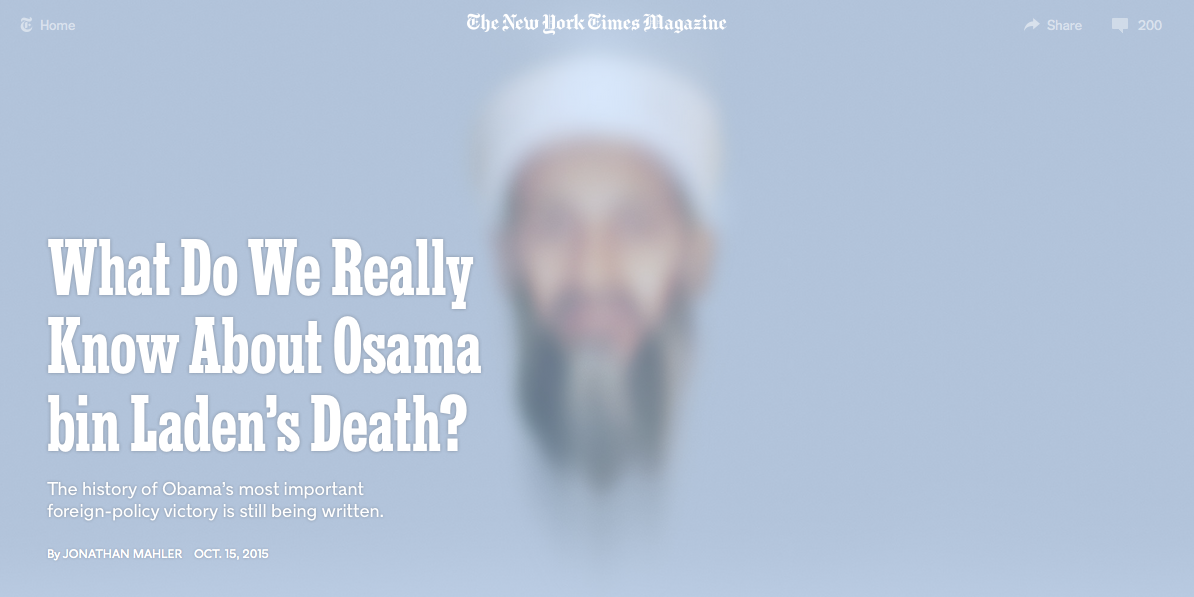
Jonathan Mahler poses this good question in a lengthy report on investigative journalism in the New York Times Magazine this week. The headline on the piece is “What Do We Really Know About Osama bin Laden’s Death?,” but the piece is essentially an examination of how investigative reporters operate. It follows how they—and others, such as the makers of the Hollywood blockbuster Zero Dark Thirty—told the story of the Bin Laden raid in Abbottabad, Pakistan in 2011.

hersh-lrb

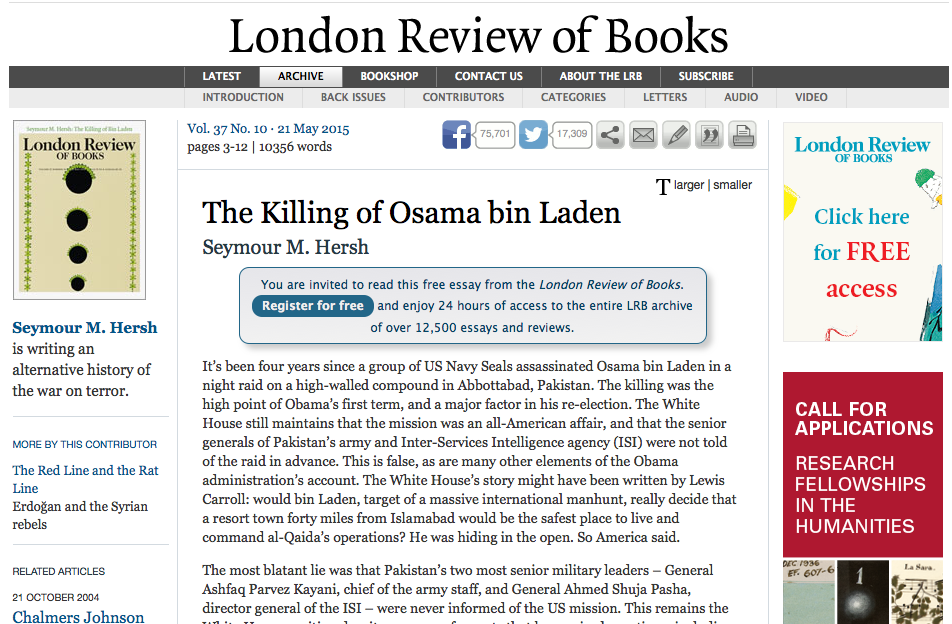
Mahler’s piece focuses on the 10,000-word article by celebrated investigative reporter Seymour Hersh in the London Review of Books, which strongly challenged the narrative of the Bin Laden raid developed by the Obama administration as well as by a number of journalists. To Hersh, famous for his stories on the My Lai Massacre and the Abu Ghraib prison abuse among many others, “the story stunk from Day 1.”

Hersh disputed the official line that Bin Laden was located due to years of methodical intelligence gathering, reporting instead that it was a tip off from a retired Pakistani intelligence officer. Rather than being a daring raid on Abbottabad, Hersh reported, Pakistani authorities were informed about the mission and allowed the U.S. Navy Seals to enter Pakistan airspace to conduct it. Hersh even reported that the Obama administration’s claim that Bin Laden had been given an Islamic burial at sea was a lie; instead, Hersh wrote, the Seals apparently tossed what was left of Bin Laden’s body out of a helicopter. The White House spokesman trashed Hersh’s story, calling it “riddled with inaccuracies and outright falsehoods.”

Although Mahler did not set out to corroborate or challenge Hersh’s account, in the end he cites a number of reports and viewpoints that prompt him to conclude that “many of Hersh’s claims could be proved right”—for example, Times correspondent Carlotta Gall had reported in 2014 on Pakistani complicity in sheltering Bin Laden.

Mahler concludes that we don’t know the whole truth of the Bin Laden raid, and it’s not only because the government is keeping it a secret: “There’s also the more modern, social-media-savvy approach: Tell the story you want them to believe. Silence is one way to keep a secret. Talking is another. And they are not mutually exclusive.”

It’s worth noting in this context, as Mahler does, that the Central Intelligence Agency reportedly cooperated with the makers of Zero Dark Thirty, who would lay claim to telling the definitive narrative of ‘‘the greatest manhunt in history.’’

obl-nyt

Hersh deserves the last word on narrative writing. As he told Mahler: “Of course there is no reason for you or any other journalist to take what was said to me by unnamed sources at face value. But it is my view that there also is no reason for journalists to take at face value what a White House or administration spokesman said on or off the record in the aftermath or during a crisis.”

At age 78, Hersh retains the fierce skepticism about government secrecy and official spin that he has been known for since breaking the My Lai Massacre story in 1969:

I love the notion that the government isn’t riddled with secrecy. Are you kidding me? They keep more secrets than you can possibly think. There’s stuff going on right now that I know about—amazing stuff that’s going on. I’ll write about it when I can. There’s stuff going out right now, amazing stuff in the Middle East. Are you kidding me? Of course there is. Of course there is.

Postscript: For some insights into how Hersh operates as a freelance journalist and investigative reporter, read the interview with him in Slate probing his Bin Laden story in LRB.

—Scott MacLeod