media chinwag

Musings on Journalism in the Online Age

Category: journalists

Turkey’s Press Crackdown

So much for the Turkish Model? After the Arab Spring, many touted the idea that Egypt and other Middle East countries should follow in Turkey’s footsteps as a Muslim nation operating on democratic principles. Among the cherished democratic principles, of course, is liberty of the press. The latest news from Turkey therefore is as distressing as it is depressing: authorities sent heavily armed police into the offices of the Zaman newspaper on March 4 and seized control of Turkey’s largest daily.

zaman

Once friendly to Recep Tayyip Erdoğan, who became president in 2014 after a decade as prime minister, Zaman has taken an increasingly critical editorial line on Turkey’s leader. Erdoğan had a political falling out with the Gulen movement, which is closely affiliated with Zaman, in 2013. Prosecutors accuse Zaman of engaging in terrorism propaganda.

The ongoing Turkish crackdown on the press extends well beyond Zaman, to reporters, columnists, and bloggers who criticize government policies or publish information deemed sensitive about national security, Kurdish demands, or Erdoğan’s rule. Turkey’s judiciary has reportedly charged some 1,800 people including many journalists under a law that prohibits “insulting the president.” Turkey has frequently blocked Twitter and YouTube, and Erdoğan has hinted at a total shutdown of social media.

Only days before the Zaman seizure, the state satellite signal provider yanked IMC TV off the air during a live broadcast—at the time, the channel was interviewing two senior Cumhuriyet journalists facing charges of exposing state secrets for reporting on the alleged transfer of weapons from Turkey to Syrian rebels.

Last fall, Turkish authorities seized the Ipek Media Group, firing journalists on its two opposition dailies and two opposition TV channels and transforming the media outlets into government mouthpieces.

According to the Committee to Protect Journalists, Turkey is among the worst jailers of journalists in the world, with 14 journalists imprisoned as of the end of 2015. It ranks 149th of 180 countries in the Reporters Without Borders World Press Freedom Index.

Today’s Zaman, the English-language version, issued a statement on the government’s seizure of the media group:

We are going through the darkest and gloomiest days in terms of freedom of the press, which is a major benchmark for democracy and the rule of law. Intellectuals, businesspeople, celebrities, civil society organizations, media organizations and journalists are being silenced via threats and blackmail.

Speaking to the New York Times, veteran political journalist Asli Aydintasbas, who  lost her column in the daily Milliyet newspaper reportedly under government pressure last year, said:

This pattern is appalling, and Turkey is galloping towards an authoritarian regime full speed ahead. Unfortunately, the world, in particular the E.U., remains silent. The government here can sense the vulnerability in the West, especially since the beginning of the refugee crisis, and is pushing the boundaries to consolidate its power.

—Scott MacLeod

Hollywood’s Spotlight on Journalism

Well, how ironic! Amid the ongoing collapse of newspaper journalism, a movie about newspaper journalists wins the big Oscar for the first time.

spotlight-poster

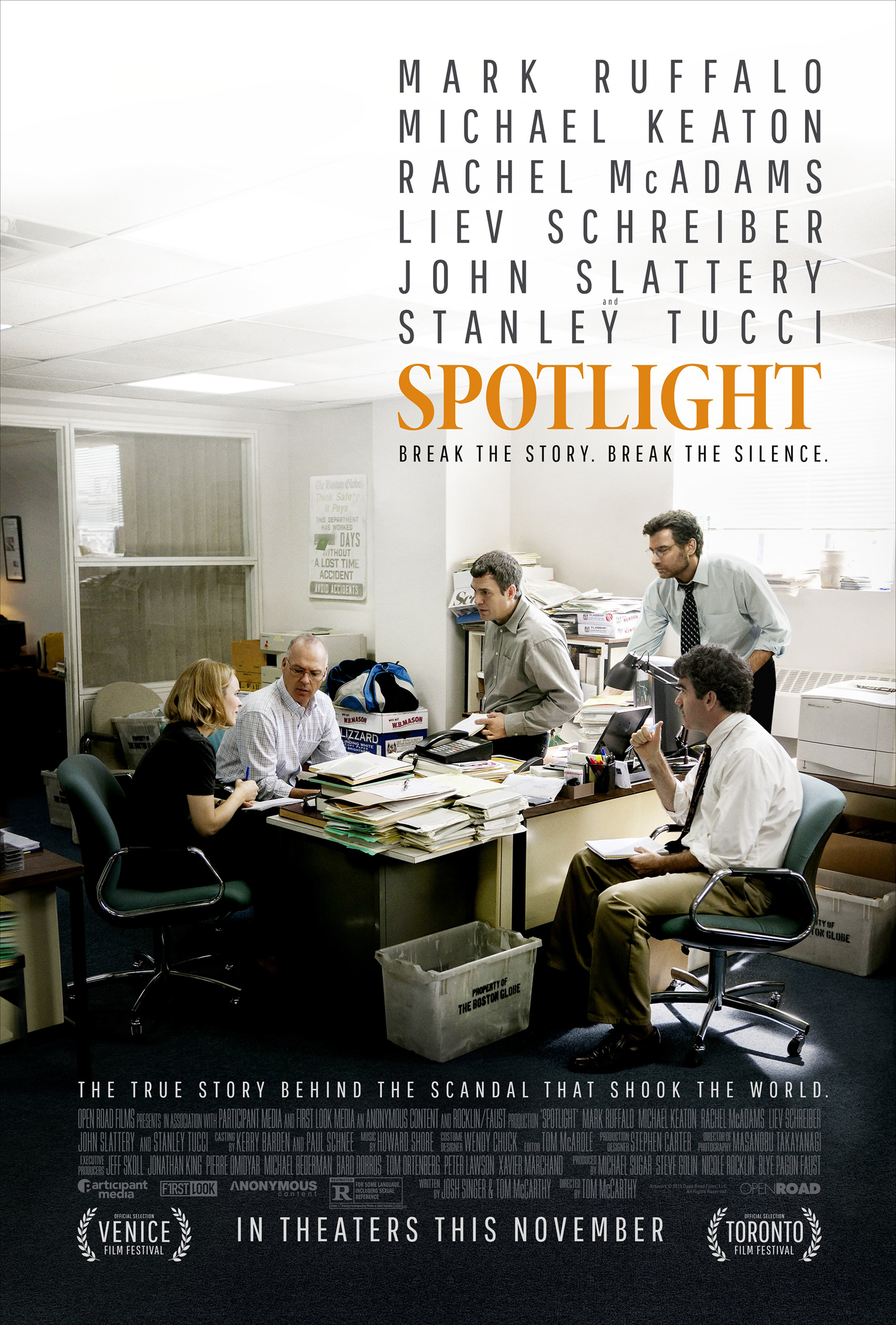
The 2015 Academy Award for Best Picture goes to Spotlight, which tells the true story of the Boston Globe Spotlight Team investigative reporting unit that revealed widespread child sex abuse by Roman Catholic priests and the cover-up of the crimes by high-level church officials.

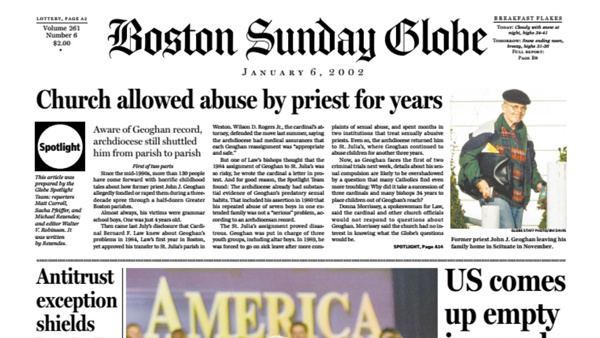
The Globe itself won the 2003 Pulitzer Prize for Public Service “for its courageous, comprehensive coverage of sexual abuse by priests, an effort that pierced secrecy, stirred local, national and international reaction and produced changes in the Roman Catholic Church.” The Globe’s Pulitzer entry included 22 stories, including the first piece in the series written by Michael Rezendes titled: “Church allowed abuse by priest for years: Aware of Geoghan record, archdiocese still shuttled him from parish to parish.”

boston-globe

Josh Singer, who along with Spotlight co-writer Tom McCarthy won the 2015 Academy Award for Best Original Screenplay, recently explained how the film’s underlying message is the importance of journalism to society:

This story isn’t about exposing the Catholic Church. We were not on some mission to rattle people’s faith. In fact, Tom came from a Catholic family. The motive was to tell the story accurately while showing the power of the newsroom—something that’s largely disappeared today. This story is important. Journalism is important, and there is a deeper message in the story.

I don’t think many understand the value of a good newsroom. The L.A. Times used to have 19 reporters covering legislature and now they have 4. When you have fewer reporters covering a story, you have far less accountability.

We wanted to spark or rekindle an interest in accurate and accountable journalism. When there is this kind of accountability among good journalists working together, it has a lasting affect on the public. Remember, Watergate was also a local story that became national.

Newspapers may be shrinking or dying, but investigative journalists are not giving up. In the Cairo Review of Global Affairs, Brant Houston reports on how non-profit news organizations are picking up some of the slack.

Here’s the Spotlight trailer


—Scott MacLeod

The Intercept, Two Years On

Adversarial muckrakers + civic-minded billionaire = a whole new world

That was the sub-headline on a Columbia Journalism Review article on October 17, 2013. It perfectly summed up the excitement many of us felt about the announcement that billionaire eBay founder Pierre Omidyar and national security journalist Glenn Greenwald were getting into the journalism business together. But, alas, the partnership still seems to be very far from reaching its objectives and potential.

intercept

By February 2014, Omidyar and Greenwald, with a barebones staff, had launched The Intercept. According to its mission statement, The Intercept is “dedicated to producing fearless, adversarial journalism. We believe journalism should bring transparency and accountability to powerful governmental and corporate institutions, and our journalists have the editorial freedom and legal support to pursue this mission.”

Over the past two years, The Intercept has undoubtedly proved to be an important new player in American journalism. It has hired stellar journalists such as—in addition to Greenwald—Laura Poitras, Jeremy Scahill, and Peter Maass. It has been a relentless watchdog on powerful people and institutions, initially as a platform for Greenwald’s ground-breaking reporting on the National Security Agency based on leaked documents from Edward Snowden.

Yet, by The Intercept’s own reckoning, the launch of the publication was severely hampered by the management style of First Look Media, the parent company Omidyar created for an envisioned $250 million investment in journalistic projects.

In June 2014, Greenwald, Poitras, Scahill and Matt Taibbi—who was hired to start a separate First Look Media publication called Racket—wrote a letter to Omidyar complaining that budgetary and personnel restrictions were jeopardizing the whole enterprise. The Intercept, already up and running with big-name journalists, managed to work out some of the kinks with First Look. But Taibbi left the company to return to Rolling Stone magazine, and First Look shut down Racket before its launch.

The recent scandal involving reporter Juan Thompson indicates that The Intercept’s organizational problems are far from over. And these problems are beginning to infect The Intercept’s credibility.

In “A Note to Readers” on February 2, 2016, Editor in Chief Betsy Reed announced the firing of Thompson, who had covered race and criminal justice issues for The Intercept since November 2014. An internal investigation had revealed that Thompson fabricated quotes, deceived editors, and lied about his reporting methods.

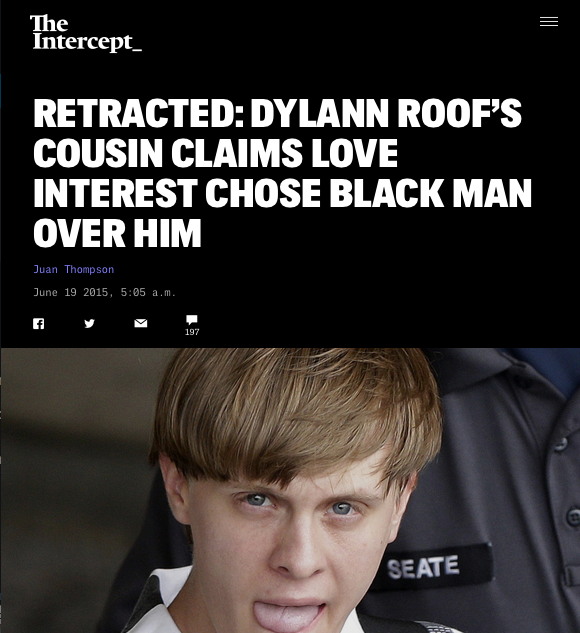
One of the egregious examples was a Thompson story dated June 19, 2015, about 21-year-old Dylann Roof, who slaughtered nine African Americans in a church in Charleston, South Carolina two days earlier. The article quoted Scott Roof, who was identified as Roof’s cousin, saying that Roof went “over the edge” when a girl he liked started dating an African American man. The Intercept’s internal investigation, which included speaking with two members of the Roof family, said the family did not know of such a cousin.

In her note, Reed accepted responsibility for the Thompson affair, apologizing to the subjects of the stories, to people who were falsely quoted, and to The Intercept’s readers. “The best way we can see to maintain the trust of readers,” she wrote, “is to acknowledge and correct these mistakes, and to focus on producing journalism we are proud of.”

That may not be enough to maintain the trust of The Intercept’s readers. The Thompson fabrications amount to an institutional scandal of great proportions, particularly for an organization that prides itself on reporting highly sensitive stories based on anonymous sources.

The Intercept should follow through with a full (and preferably independent) investigation into Thompson’s career and work at the publication. The review should not only cover Thompson’s reporting methods and deceptions, but the editorial process that enabled him to get away with the fabrications. Precedents for such accountability have been set by other publications, notably the New York Times in the Jayson Blair scandal, and Rolling Stone in the case of its discredited story about a vicious gang rape at a college fraternity house.

Also curious is The Intercept’s decision to keep Thompson’s 40-some stories for the publication as well as his biography on its website. The Dylann Roof story is labeled “Retracted” with an editor’s note explaining why, and four other stories are labeled “Corrected” with similar editor’s notes.

However well intended, this approach does nothing to restore the breach of trust that The Intercept has created with its readers. It leaves the impression that everything is more or less okay, except for a few errors here and there by a lone reporter that have now been “corrected.” It leaves the mea culpa seeming half-hearted.

Perhaps a better idea is for The Intercept’s homepage to display a prominent hyperlinked “Correcting the Record” box, where readers would be taken to a full report on the affair and an account of measures being taken to prevent future breakdowns in the editorial process.

If Thompson’s bio is to remain, it should  be accompanied by text clearly explaining his role in the breach of trust. His journalism should be transparently removed from the website, or kept in a special section devoted entirely to the scandal. Readers can hardly have any confidence in his articles after his own editor in chief stated that “Thompson went to great lengths to deceive his editors, creating an email account to impersonate a source and lying about his reporting methods.”

After all its organizational problems, New Look Media is well advised to get its act together. This is an outfit that was flung together too quickly, without regard for the importance of creating a foundational institutional culture suited to the work of journalism. Omidyar  formed the partnership with Greenwald within a few weeks of meeting him for the first time, without even discussing roles and responsibilities. Omidyar’s idea resembled what New York University’s Jay Rosen calls the “personal franchise model” of assembling star journalists and supporting them.

The Intercept itself diagnosed the problem with this idea, in a remarkable article it published in October 30, 2014 about the turmoil within First Look Media that led to Matt Taibbi’s exit:

First Look and the editorial staff it hired quickly learned that it is much easier to talk about such high-minded, abstract principles than it is to construct an organization around them. The decision to create a new editorial model left space for confusion, differing perspectives, and misaligned expectations.

—Scott MacLeod

Access Journalism

The risk of falling prey to political manipulators is an occupational hazard for journalists. It is particularly so for those whose beats provide off-the-record background briefings and other tantalizing opportunities for access to powerful people in high places—for example, senior policy makers at the White House, Pentagon, State Department, Central Intelligence Agency, etc. Access to power and the “scoops” that can result is a rush for driven journalists in cutthroat competition for front page real estate and the glory and money that can accrue.

atlantic

A notorious case in point, of course, is former New York Times reporter Judith Miller, who said “I was wrong because my sources were wrong” after her misleading reporting on Saddam Hussein’s WMD programs helped the Bush administration build its case for the 2003 invasion of Iraq.

Though a relatively innocuous example, an email exchange between then-Secretary of State Hillary Clinton’s spokesman and a journalist for the Atlantic provides a rare and revealing insider glimpse at the practice of Washington hacks cozying up to powerful sources.

Atlantic politics editor Marc Ambinder emailed Clinton spokesman Philippe Reines on July 15, 2009 asking for an advance copy of a speech Clinton would be giving at the Council on Foreign Relations in New York. Reines responded by offering the speech, but on three conditions:

1) You in your own voice describe them as “muscular”

2) You note that a look at the CFR seating plan shows that all the envoys—from Holbrooke to Mitchell to Ross—will be arrayed in front of her, which in your own clever way you can say certainly not a coincidence and meant to convey something

3) You don’t say you were blackmailed!

Ambinder immediately responded, “got it,” and complied: the first paragraph of his scoop for the Atlantic dutifully called Clinton’s speech “muscular” and noted that the three envoys would be “seated in front of Clinton, subordinate to Clinton.” The piece’s headline: “Hillary Clinton’s ‘Smart Power’ Breaks Through.”

Gawker’s J.J. Trotter reported on the email exchange, which Gawker obtained in a Freedom of Information Act request for Reines’ email exchanges with journalists. In the Washington Post, media critic Erik Wemple called the exchange a “Beltway bucket of slime.”

Miller, in her 2015 autobiography The Story: A Reporter’s Journey, continued to deny any fundamental professional lapse in relying on dubious sources. By contrast, Ambinder, who has since left the Atlantic to become a Los Angeles-based writer and producer, honorably acknowledged his error to Gawker:

It made me uncomfortable then, and it makes me uncomfortable today. And when I look at that email record, it is a reminder to me of why I moved away from all that. The Atlantic, to their credit, never pushed me to do that, to turn into a scoop factory. In the fullness of time, any journalist or writer who is confronted by the prospect, or gets in the situation where their journalism begins to feel transactional, should listen to their gut feeling and push away from that.

Being scrupulous at all times will not help you get all the scoops, but it will help you sleep at night. At no point at The Atlantic did I ever feel the pressure to make transactional journalism the norm.

—Scott MacLeod

Chasing the Bin Laden Story

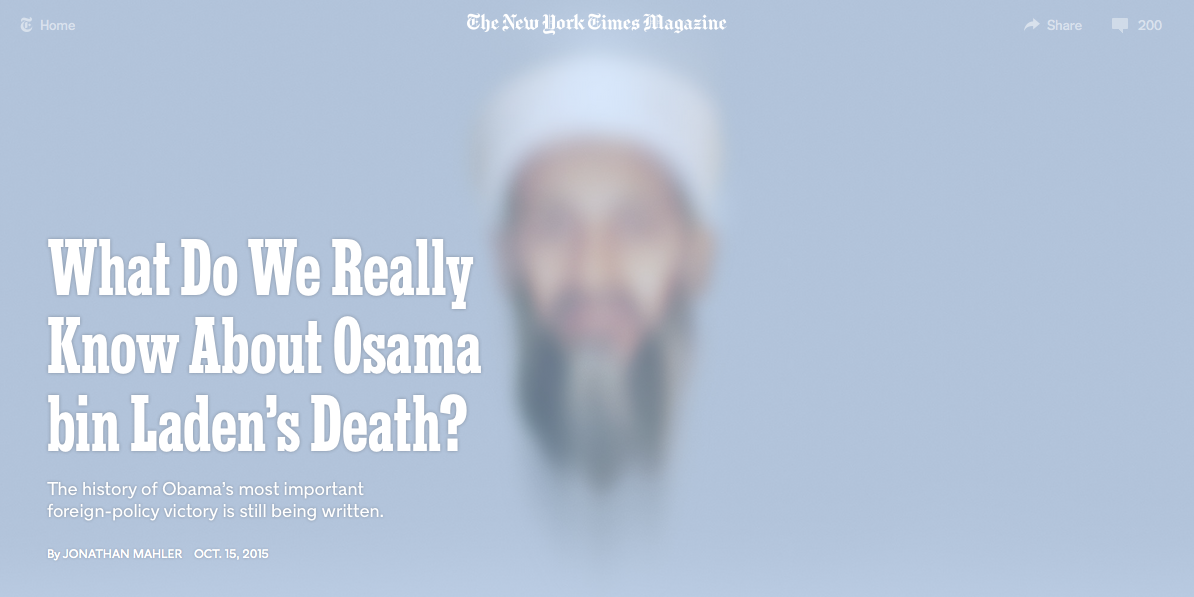
Reporters like to think of themselves as empiricists, but journalism is a soft science. Absent documentation, the grail of national-security reporting, they are only as good as their sources and their deductive reasoning. But what happens when different sources offer different accounts and deductive reasoning can be used to advance any number of contradictory arguments?

Jonathan Mahler poses this good question in a lengthy report on investigative journalism in the New York Times Magazine this week. The headline on the piece is “What Do We Really Know About Osama bin Laden’s Death?,” but the piece is essentially an examination of how investigative reporters operate. It follows how they—and others, such as the makers of the Hollywood blockbuster Zero Dark Thirty—told the story of the Bin Laden raid in Abbottabad, Pakistan in 2011.

hersh-lrb

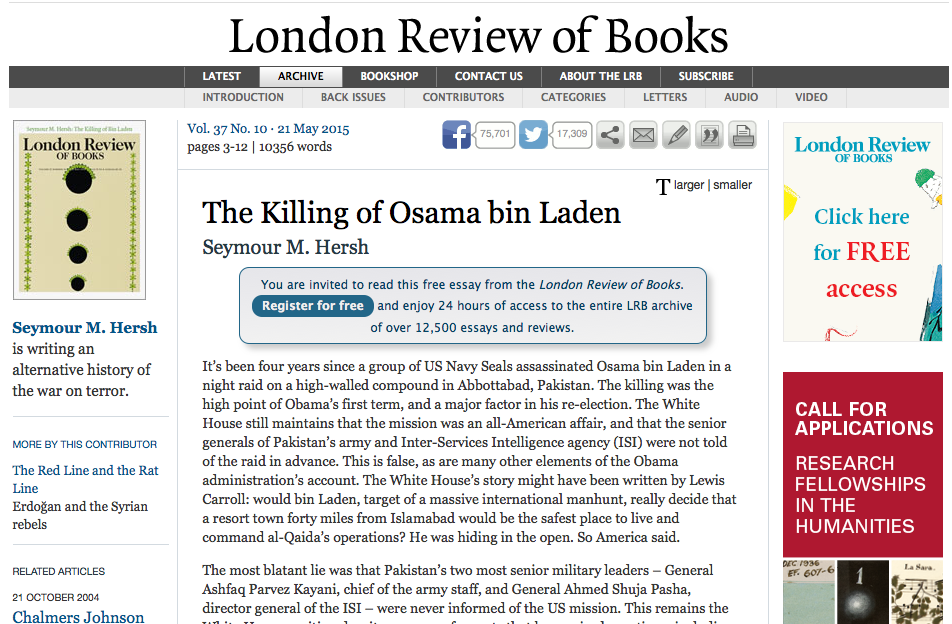
Mahler’s piece focuses on the 10,000-word article by celebrated investigative reporter Seymour Hersh in the London Review of Books, which strongly challenged the narrative of the Bin Laden raid developed by the Obama administration as well as by a number of journalists. To Hersh, famous for his stories on the My Lai Massacre and the Abu Ghraib prison abuse among many others, “the story stunk from Day 1.”

Hersh disputed the official line that Bin Laden was located due to years of methodical intelligence gathering, reporting instead that it was a tip off from a retired Pakistani intelligence officer. Rather than being a daring raid on Abbottabad, Hersh reported, Pakistani authorities were informed about the mission and allowed the U.S. Navy Seals to enter Pakistan airspace to conduct it. Hersh even reported that the Obama administration’s claim that Bin Laden had been given an Islamic burial at sea was a lie; instead, Hersh wrote, the Seals apparently tossed what was left of Bin Laden’s body out of a helicopter. The White House spokesman trashed Hersh’s story, calling it “riddled with inaccuracies and outright falsehoods.”

Although Mahler did not set out to corroborate or challenge Hersh’s account, in the end he cites a number of reports and viewpoints that prompt him to conclude that “many of Hersh’s claims could be proved right”—for example, Times correspondent Carlotta Gall had reported in 2014 on Pakistani complicity in sheltering Bin Laden.

Mahler concludes that we don’t know the whole truth of the Bin Laden raid, and it’s not only because the government is keeping it a secret: “There’s also the more modern, social-media-savvy approach: Tell the story you want them to believe. Silence is one way to keep a secret. Talking is another. And they are not mutually exclusive.”

It’s worth noting in this context, as Mahler does, that the Central Intelligence Agency reportedly cooperated with the makers of Zero Dark Thirty, who would lay claim to telling the definitive narrative of ‘‘the greatest manhunt in history.’’

obl-nyt

Hersh deserves the last word on narrative writing. As he told Mahler: “Of course there is no reason for you or any other journalist to take what was said to me by unnamed sources at face value. But it is my view that there also is no reason for journalists to take at face value what a White House or administration spokesman said on or off the record in the aftermath or during a crisis.”

At age 78, Hersh retains the fierce skepticism about government secrecy and official spin that he has been known for since breaking the My Lai Massacre story in 1969:

I love the notion that the government isn’t riddled with secrecy. Are you kidding me? They keep more secrets than you can possibly think. There’s stuff going on right now that I know about—amazing stuff that’s going on. I’ll write about it when I can. There’s stuff going out right now, amazing stuff in the Middle East. Are you kidding me? Of course there is. Of course there is.

Postscript: For some insights into how Hersh operates as a freelance journalist and investigative reporter, read the interview with him in Slate probing his Bin Laden story in LRB.

—Scott MacLeod

A Tribute to Éric Rouleau (1926–2015)

Éric Rouleau had a deep relationship with Egypt and the Middle East—he was Le Monde’s correspondent in the region for 30 years, and later served as France’s ambassador to Tunisia and to Turkey. He was born in Cairo, began his journalism career on the Egyptian Gazette, and maintained a lifelong attachment to his native country.

A tribute to Éric will be held in Cairo on October 13 on the occasion of the Arabic translation of Éric’s final work, Dans les coulisses du Proche-Orient: Mémoires d’un journaliste diplomate (1952-2012). The event is hosted by American University in Cairo’s Middle East Studies Center, the Institut Francais d’Egypte, and the Al-Tanany Publishing House.

eric

One of the speakers is longtime Le Monde Diplomatique Editor-in-Chief Alain Gresh, who wrote a poignant appreciation of Éric’s life and career in Orient XXI last March. A translation appears in the Cairo Review of Global Affairs. Here’s a brief excerpt:

In 1985, Rouleau transitioned to a diplomatic career at the request of President Mitterand. He was appointed ambassador, first to Tunis—then headquarters of the Arab League, and the city where the Palestinian Liberation Organization sought refuge after its expulsion from Beirut in 1982—and later to Ankara. After this time, only diplomats would benefit from his culture, analyses, and countless connections. Ironically, Rouleau himself noticed that the number of his readers dropped from hundreds to two, and even sometimes one—the president of the Republic.

During the first meeting of French ambassadors held in Paris after his appointment, each of the diplomats introduced themselves and their country of assignment—for example the Ivory Coast, Jordan, Argentina, etc. When it was his turn, he stood up and said: “Éric Rouleau, Le Monde.” There was silence, then the audience broke into laughter. Freud believed that slips of the tongue expressed unconscious desires. Did Rouleau consider himself the ambassador of the daily newspaper? Or did he see himself as ambassador to the world, monde in French, as he crossed from north to south? Or, might he have simply meant that he was our ambassador to a planet whose glitches he would help us solve?

Also, read “Cairo: A Memoir,” by Éric Rouleau in the Summer 2012 edition of the Cairo Review.

5029_MESC-Eric Rouleau-2-Sep2015_1

“A Tribute to Éric Rouleau (1926–2015)” will be held in Oriental Hall, AUC Tahrir Campus, from 6 p.m. to 8:30 p.m. on Tuesday October 13.

—Scott MacLeod


French Press: Mon Dieu!

France’s crise de la presse has no end in sight. Like almost everywhere, France’s print newspapers are grappling with declining sales, slumping ad revenues, and the challenges posed by digital media—how to join the digital revolution, or be crushed by it.

WWD has an interview with Francis Morel, CEO of France’s Les Echo Group, that gives a glimpse into the boardroom forces driving change in the French media. Among those forces: the takeover of French newspapers by conglomerates with no experience in journalism or professional stake in a free press; a trend toward boutique products like weekend magazines to attract elite readers and advertisers who want to reach them; and a determination to exploit marquee newspaper brands to develop consulting units and other sidelines.

morel-photo

Morel reports that such services could soon represent almost half of the business at Les Echos, which began publishing as France’s first daily financial newspaper in 1908:

There are always activities to develop to complement the main business of media. We launched Les Echos Solutions in June with services ranging from crowdfunding to market studies and incubators for start-up companies. We are developing a publishing arm for companies with a separate staff. Services will represent one-third of the group sales in 2016. Down the road, they could be up to 45 percent of Les Echos’ business. We define ourselves as “the first media outlet for information and services,” which makes us stand out. On the services front, I think we are at the forefront.

Les Echos is just another case of how French journalists find themselves entwined with conglomerates. The paper was closely held by the Schreiber family and then the Beytout family for eight decades before being sold to Britain’s Pearson PLC, itself a publishing and education company. In 2007, Pearson sold it to LVMH, the French luxury goods conglomerate focused on brands like Louis Vuitton, Christian Dior, and Moët & Chandon. Under Morel, Les Echos Group is now about to take ownership of two more French dailies, Le Parisien and its national counterpart, Aujourd’hui en France. That will put Les Echos Group in the top rank of French mainstream press, along with Le Monde and Le Figaro.

The marriage of journalists and conglomerates has not been a happy one. Shortly after the LVMH acquisition of Les Echos, editor Erik Israelewicz resigned over alleged editorial interference, and his staff went on strike to insist on editorial independence. Similar tensions arose in 2010 when a trio of French tycoons took control of Le Monde: Matthieu Pigasse, Pierre Bergé, and Xavier Niel. Since then, the paper has gone through five chief editors. (The trio, meanwhile, has acquired Le Nouvel Observateur, now simply L’Obs, a leading French newsweekly). Le Figaro, another French newspaper of record, is owned by the Dassault Group, known for its aerospace business in Mirage fighter bombers and other military aircraft.

libe

Critics accuse the French (and their labor unions) of being resistant to change. Where independent journalism is at stake, that may not be a bad thing at all. Last year journalists at Libération went on strike against a plan by its shareholders led by chairman Édouard de Rothschild (38.6 percent share) to “save” the paper—besides the usual staff cutbacks, the plan would turn the newspaper’s headquarters into a cultural center and reinvent the paper itself as a social network. Journalists at Libération, which was founded by philosopher Jean-Paul Sartre after the 1968 student and worker upheavals in France, explained their walkout with the front-page headline:

WE ARE A NEWSPAPER not a restaurant, not social media, not a TV studio, not a bar, not a startup incubator…

—Scott MacLeod

The Press, the Public, and the President

Leslie T. Chang has a good report in NYR Daily titled “Egypt’s Media: Endorsing Repression.” She writes on how journalists, perhaps notably the country’s influential political talk show hosts, are making energetic efforts to build a consensus behind the policies of President Abdel Fattah El-Sisi. It seems to be helping: the leader’s approval rating after a year in office was around 90 percent.

Abroad, the Sisi administration is criticized for allowing more than a thousand people thought to be sympathetic to Morsi to be sentenced to death in mass trials; in Egypt, newspaper columnists say they should be executed without trial. Journalists occasionally criticize government performance on issues like education, health care, or religious policy. But as I discovered in interviews with leading talk show hosts and editors, they regard the defining feature of Sisi’s administration—the use of state-sanctioned violence and politicized trials to maintain order and crush its opponents—with near-unanimous approval.

media control

Chang reports on El-Sisi’s moves to influence the media, holding monthly meetings with editors and presenters, and telling television hosts they are responsible “for promoting unity and raising morale.”

As Chang notes, it’s not simply an issue of control from above. Egyptian journalists, especially those working for the independent media, were increasingly free to report during the last years of the Hosni Mubarak era—criticism of the president and even his family was tolerated. Journalists briefly became more assertive in their watchdog role after the January 25, 2011 uprising that ended Mubarak’s 30-year rule. In one of the most celebrated examples, Ahmed Shafik, an interim prime minister, abruptly resigned from office after being aggressively questioned on Baladna bel Masry, a political talk show on ONTV hosted by Reem Magued.

But the Egyptian public mood has become deeply fearful of instability, due to the polarizing presidency of the Muslim Brotherhood’s Mohammed Morsi, the protests and violence involved in his removal from office, the rise of jihadist chaos throughout the Arab word including in Egypt, and the nosedive of the Egyptian economy. El-Sisi is seen by millions as the nation’s protector—and only hope. Many journalists share the fears, or at least are influenced by the public’s intolerance for any further destabilization of the state. (The logic was no doubt at play last week in the Egyptian government’s ban on media coverage of the Egyptian military’s lethal attack on suspected insurgents who turned out to be Mexican tourists—few Egyptians want to see their army’s honor besmirched.)

Chang concludes:

In the two years since the army removed Morsi after huge demonstrations against him, the mainstream media has lost most of the openness it briefly enjoyed. Especially during major political events, the press speaks in one voice; journalists who break ranks sometimes find themselves vilified—not by the government but by their own colleagues and the public.

Egypt’s revolution taught the world that the power of a dictator can dissolve in an instant. But the lesson of the years since may be that, in a country threatened by chaos and violence, authoritarianism can hold a powerful appeal of its own.

—Scott MacLeod

Reporting from Egypt

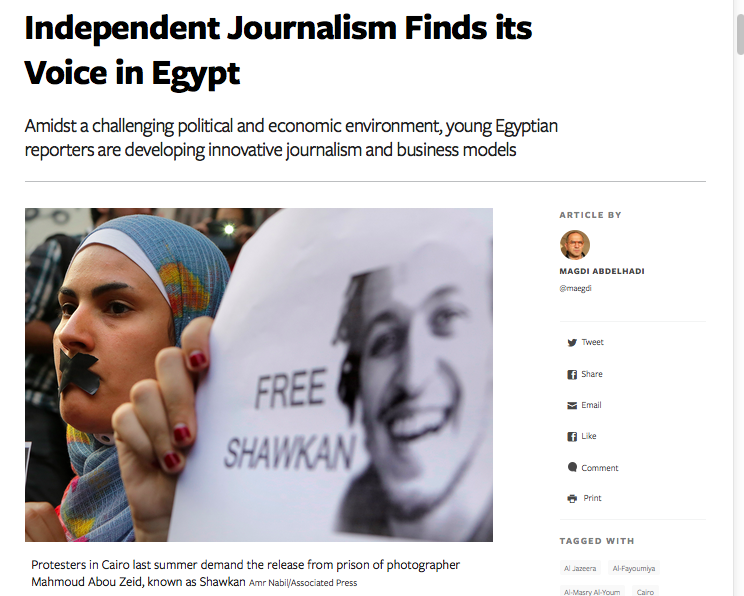
Magdi Abdelhadi has a nice piece in Nieman Reports about the struggles of independent media in Egypt. Among other things it highlights the work of Mada Masr and its editor, Lina Attalah (American University in Cairo ’04):

In 2013, Lina Attallah and her colleagues lost their jobs at Egypt Independent, the English-language edition of the flagship daily, Al-Masry Al-Youm. After a dispiriting series of editorial and financial disputes with their bosses, Attallah and her colleagues decided to start Mada Masr (“Egypt’s Horizon”), an English-Arabic news and arts website that caters primarily to Egypt’s well-educated cultural elite, rather than look for jobs at other mainstream outlets. “There was nowhere else to work,” says Attallah. “It was a time when media freedom became more and more limited. No media outlet could afford to hire independent journalists who wouldn’t compromise the content. And that is why we had to build our own space.”

egyptindependent

Amir-Hussein Radjy profiled Mada Masr in the Summer 2015 edition of the Cairo Review of Global Affairs. Leslie T. Chang wrote an in-depth report on the organization in The Long Read section of the Guardian last January.

There are brave journalists out there doing the best work that can be done  in Egypt under present circumstances. In August, President Abdel Fattah El-Sisi signed a new counterterrorism law that, according to Human Rights Watch, “makes it a crime to publish or promote news about terrorism if it contradicts the Defense Ministry’s official statements and would allow the courts to temporarily ban journalists from practicing their profession for doing so.”

—Scott MacLeod

The Journalists’ Bard

It’s a grand, grand caper. You get to leave, go talk to strangers, ask them anything, come back, type up their stories, edit the tape. That’s not gonna retire your loans as quickly as it should, and it’s not going to turn you into a person who’s worried about what kind of car they should buy, but that’s kind of as it should be. I mean, it beats working.

—David Carr (1956-2015)

That’s from David Carr’s commencement address in 2014 at the University of California, Berkeley, Graduate School of Journalism, a paean to his profession that manages to be sentimental and hard-boiled at the same time. As the Media Equation columnist and culture writer for the New York Times, Carr captured the zeitgeist of a world turned upside down by the Internet better than anyone.

“David was a bard for journalists because he figured out how to connect our past with our present,” David Leonhardt wrote in an appreciation in the Times. “He venerated old-fashioned reporting and yet described today as a ‘golden age’ for journalists.”

Carr collapsed in the Times’ newsroom and later died of complications from lung cancer last February, at age 58. He lives on; for example, here in the video of his Berkeley commencement address, as well as in Page One, Andrew Rossi’s great 2011 documentary about the New York Times struggling with the transformation of the news business.

—Scott MacLeod