
Are Millennials Newsless?
In a column in The Hill earlier this year titled “The young and the newsless,” Washington strategy consultant Mark Mellman summed up a number of studies indicating that young Americans are not paying attention to politics and public affairs. Data suggested that Millennials—young adults aged 18–34—don’t follow news online, in newspapers, or on television. “The simple truth,” Mellman argued, “is that young people do not like news.”
For another take on this issue, see the studies issued in 2015 by the Media Insight Project, a collaboration of the American Press Institute, Associated Press, and NORC Center for Public Affairs Research at the University of Chicago: “Breaking Down the Millennial Generation: A Typology of Young News Consumers,” issued in September; and “How Millennials Get News: Inside the Habits of America’s First Digital Generation,” issued in March.

The March study found that nearly two-thirds of American Millennials “keep up with what’s going on in the world and/or read or watch news.” The study said that the young people are getting their news through networks such as social media, rather than traditional “news sessions”—sitting down to read the daily newspaper, or switching on World News Tonight every time the clock strikes 6:30 p.m.
For Millennials, the study reported:
Keeping up with the world is part of being connected and becoming aware more generally, and it often but not always occurs online. In many cases, news comes as part of social flow, something that may happen unexpectedly and serendipitously as people check to see what’s new with their network or community of friends… This generation tends not to consume news in discrete sessions or by going directly to news providers. Instead, news and information are woven into an often continuous but mindful way that Millennials connect to the world generally, which mixes news with social connection, problem solving, social action, and entertainment…
By any number of measures, staying in touch with the world is an important part of the lives of the first generation of digital adults…
Millennials are hardly newsless, uninterested, or disengaged from news and the world around them.
A few key points in the study:
Receiving news through networks may broaden rather than restrict exposure to different ideas:
Contrary to the idea that social media creates a polarizing “filter bubble,” exposing people to only a narrow range of opinions, 70 percent of Millennials say that their social media feeds are comprised of diverse viewpoints evenly mixed between those similar to and different from their own. An additional 16 percent say their feeds contain mostly viewpoints different from their own. And nearly three-quarters of those exposed to different views (73 percent) report they investigate others’ opinions at least some of the time—with a quarter saying they do it always or often.
Millennials are actually willing to pay for information, but tend to feel that news should be freely available for all:
When it comes to paying for the news, 40 percent of Millennials report paying for at least one subscription themselves, including a digital news app (14 percent), a digital magazine (11 percent), a digital subscription to a newspaper (10 percent), or a paid email newsletter (9 percent). When subscriptions used but paid for by others are added, that number rises to 53 percent who have used some type of paid subscription for news in the last year.
Interestingly, this digital generation is more likely to have paid for non-digital versions of these products. For instance, 21 percent say they have paid in the last year for a subscription to a print magazine, and 16 percent for a print newspaper, rates that are higher than for digital versions of the same products.
News publishers also may have some work to do in the digital space when it comes to subscriptions. In the qualitative interviews, we heard the notion that, because news is important for democracy, people feel they should not have to pay for it. It should be more of a civic right because it is a civic good.
Facebook and search engines like Google are critical pathways for Millennials’ acquisition of news information:
Facebook has become a nearly ubiquitous part of digital Millennial life. On 24 separate news and information topics probed, Facebook was the No. 1 gateway to learn about 13 of those, and the second-most cited gateway for seven others…
When Millennials want to dig deeper on a subject, search is the dominant method cited by 57 percent (and it is the one cited most often as useful).
The September study classifies Millennial news consumers into four categories: the Explorers and the Activists (the groups more likely to seek out news and information online) and the Unattached and the Distracted (well, you get the idea). Eight-five percent and 80 percent of Explorers and Activists, respectively, regularly go online to learn what’s going on in the world; and 44 and 51 percent pay for a news subscription (compared to 31 and 40 percent of the Unattached and the Distracted).
The API-AP-NORC studies may prove that Millennials are not completely “newsless,” but I am not too reassured. The finding on search engines may highlight the problem: when Millennials want to dive deeply into a topic, fewer than 5 percent turn to a national newspaper (in print or online) and the figure is about the same for local newspapers. The study seems to confirm that young people do not fully understand and appreciate the importance of journalism in our societies—the presentation of reliable news by professionals using a well-developed discipline for assembling, verifying, and being accountable for facts. As the Center for News Literacy at the Stony Brook University School of Journalism warns:
News aggregators, bloggers, pundits, provocateurs, commentators and “citizen journalists” are competing with traditional journalists for public attention. Uninformed opinion masquerades as news. Lines are blurring between legitimate journalism and the propaganda, entertainment, self-promotion and unmediated information on the Internet. This superabundance of information has made it imperative that citizens learn to judge the reliability of news reports and other sources of information that is passed along their social networks.
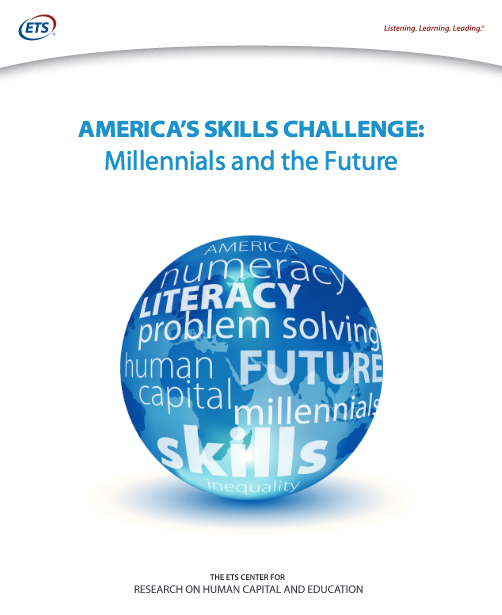
Another study released in 2015 should justify concerns about the news literacy of the current and coming digital generations: “America’s Skills Challenge: Millennials and the Future,” published by the Educational Testing Service’s Center for Research on Human Capital and Education. It found that young adults in the United States fall short of Millennials in other developed countries when it comes to the skills employers want most: literacy, practical math, and problem-solving in technology-rich environments. The study also found that the U.S. Millennials lagged behind other age groups within America itself. This is in a context in which 43 percent of Americans have earned college degrees, and 90 percent of Millennials now own a smartphone.
Equally troubling is that these findings represent a decrease in literacy and numeracy skills for U.S. adults when compared with results from previous adult surveys… In literacy, U.S. Millennials scored lower than 15 of the 22 participating countries. Only Millennials in Spain and Italy had lower scores.
The ETS study defined literacy as “the ability to understand, evaluate, use, and engage with written text to participate in society, to achieve one’s goals, and to develop one’s knowledge and potential.”
—Scott MacLeod
 media chinwag