media chinwag

Musings on Journalism in the Online Age

Category: media transformation

NYT: “Our Path Forward”

Its 96-page internal “Innovation” report in March 2014 called for a strategy to make the New York Times newsroom “a truly digital-first organization.” Last month, the strategy was unveiled, and it might rather be termed a “mobile-first” strategy.
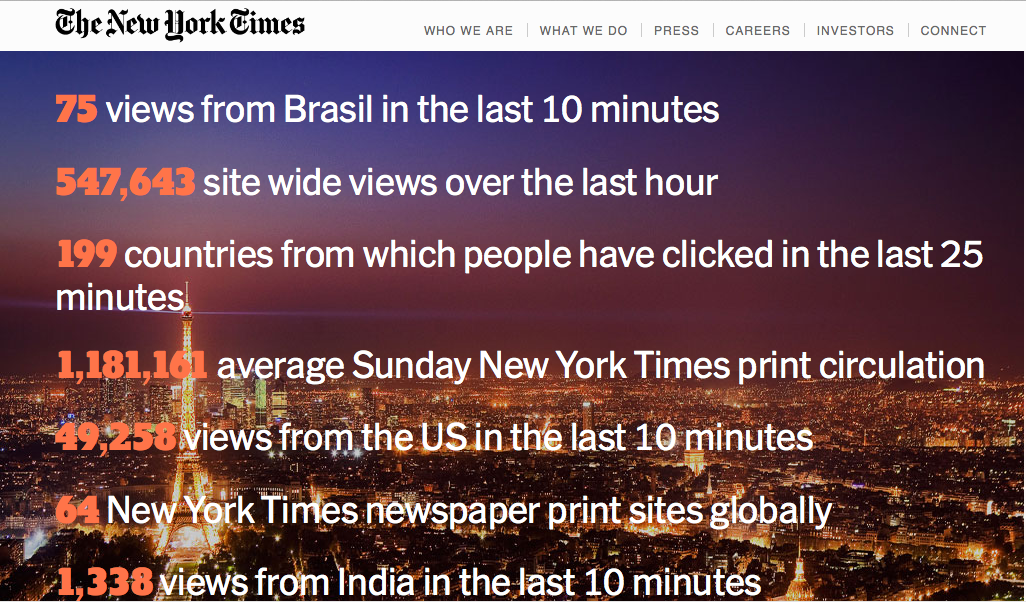
Screen

Executive Editor Dean Baquet, Chairman and Publisher Arthur O. Sultzberger Jr., and eight other officials of the 164-year-old newspaper company declared in an 11-page memo solemnly titled “Our Path Forward”: “Our company was built for the print era and now must be redesigned for the mobile era… Our first two million subscribers grew up with The New York Times spread out over their kitchen tables. The next million must be fought for and won over with The Times on their phones.”

The memo noted that in the last five years, the newspaper has doubled its digital revenues to $400 million. The headline from the memo was a goal to double the digital revenues again to $800 million by 2020. Last summer, the Times announced that it had surpassed the 1 million mark in digital subscribers.

The Times is making an impressive effort to figure out how a major news organization rooted in the print era can survive in the digital era. With so much at stake—the Times‘ epic contribution to American journalism, the legacy of a great newspaper family—one assumes this strategy is as cutting edge as it gets. But will it work?

The Times is betting on its uniqueness. It is betting that the best business model should focus on getting users to pay for Times journalism—on the basis of the uniquely high quality product it offers—rather than depending on advertising revenues.  The Times is betting on digital subscriptions, and it believes that loyalty of digital subscribers is what will drive whatever digital advertising it also manages to attract.

From the memo:

Though “user-­first” has become a popular buzz phrase in recent years, it has real meaning for us. While most of our competitors chase scale, our unique business model is built on directly asking our most loyal readers to help us pay for our massive news gathering operation.  In addition to contributing all of our digital subscription revenue, they also are responsible for driving the majority of our advertising revenue  through their deep engagement. The sustainable path to long-­term revenue growth requires that we always prioritize user experience and  the needs of our customers over hitting quarterly revenue targets.  These deep reader relationships are our  most valuable  asset.

The Times newsroom, 1,300 journalists strong, has already re-geared as a digital-first organization. The memo accepts the “inevitable decline in print.” But the memo’s talk about the need to “deepen the engagement with our current readers” and “building new relationships with people around the world” is a leap of faith.

The Times has prioritized hiring journalists “with new skills in graphics, video, technology, design, data, audience engagement and much more.” In outlining fresh approaches for the digital era, the memo points to innovations like digital storytelling techniques, big multimedia projects, video reports, liveblogging, mobile phone alerts, newsletters, translations, service journalism, and new formats like Apple Watch and Snapchat. These are in line with the Times‘ core goal of making the user experience as enriching and personal as possible.

Yet, it’s not clear how those wonderful features produced by digital-savvy journalists are going to enable the Times to keep its 2 million current paying customers—one million of them buying the print paper—let alone recruit new ones. Undoubtedly news consumers everywhere will continue to love reading the Times. The question is whether enough of them will be willing to pay for it.

The memo predicts that “over the next few years, the battle is going to be won or lost on smart phones.” Yet, mobile devices with five-inch display screens don’t seem to be a very ideal platform to support what the memo rightly calls “ambitious, original, high-quality journalism that is essential for an informed society.”

In the last few financial reporting quarters, the Times has been clocking 20 percent or so increases in its digital subscribers—no doubt, one of the reasons for the surprising confidence expressed in “Our Path Forward.”

Other numbers continue to be sobering, however. Digital advertising revenues, though steadily improving across the industry, only contribute about one-third to overall ad revenues. Print ad revenues have been steadily declining at the Times in 2015—down 11 percent in the first quarter, 13 percent in the second quarter, and about 1 percent in the third quarter. In the third-quarter results released at the end of October, just three weeks after the “Our Path Forward” memo was issued, even digital ad revenues declined by 5 percent. As the memo says, “for all we’ve accomplished, our digital business is not yet close to supporting the scale of our ambitions.”

The Times’ strategy is a clear-headed appraisal of the challenges it faces, and a reasonable action plan for survival in the digital era. It aims to not only survive but thrive. The Times‘ goal is nothing less than attracting readers who will “build a lifetime relationship with The New York Times.” Times‘ executives deserve enormous credit for their unyielding commitment to quality journalism rather than bottom lines. Yet the Times‘ future depends to a great extent on dynamics outside its control.

The memo notes, for example, that the Times will particularly focus on younger readers, who are “reliable first indicators of major trends that ultimate affect our entire audience.” Already the under-35s make up 40 percent of the Times’ mobile audience. But studies show that these so-called Millennials have adopted digital media consumption habits for the digital age—digital natives are getting their news from networks such as social media more than via destination news sites. It is far from certain that the Times will be able to demonstrate to this demographic “the unique value of consuming The Times on our own platforms.” The memo acknowledges the ominous phenomenon of readers’ “changing habits.”

As the memo notes:

Skeptics still openly wonder if we can continue to deliver on this journalistic mission, given the seeming mismatch between the economics of news media and the scale of our operations. They suggest the days when a media company can fund a big, ambitious  newsroom are over. They doubt we can continue to cut legacy costs and fund digital innovation at the same time.

These are serious and fair questions. The most pressing challenge is not to prove that our journalism matters—it’s to demonstrate that our business can continue to support this mission.

—Scott MacLeod

Are Millennials Newsless?

In a column in The Hill earlier this year titled “The young and the newsless,” Washington strategy consultant Mark Mellman summed up a number of studies indicating that young Americans are not paying attention to politics and public affairs. Data suggested that Millennials—young adults aged 18–34—don’t follow news online, in newspapers, or on television. “The simple truth,” Mellman argued, “is that young people do not like news.”

For another take on this issue, see the studies issued in 2015 by the Media Insight Project, a collaboration of the American Press Institute, Associated Press, and NORC Center for Public Affairs Research at the University of Chicago: “Breaking Down the Millennial Generation: A Typology of Young News Consumers,” issued in September; and “How Millennials Get News: Inside the Habits of America’s First Digital Generation,” issued in March.

millennials-photo

The March study found that nearly two-thirds of American Millennials “keep up with what’s going on in the world and/or read or watch news.” The study said that the young people are getting their news through networks such as social media, rather than traditional “news sessions”—sitting down to read the daily newspaper, or switching on World News Tonight every time the clock strikes 6:30 p.m.

For Millennials, the study reported:

Keeping up with the world is part of being connected and becoming aware more generally, and it often but not always occurs online. In many cases, news comes as part of social flow, something that may happen unexpectedly and serendipitously as people check to see what’s new with their network or community of friends… This generation tends not to consume news in discrete sessions or by going directly to news providers. Instead, news and information are woven into an often continuous but mindful way that Millennials connect to the world generally, which mixes news with social connection, problem solving, social action, and entertainment…

By any number of measures, staying in touch with the world is an important part of the lives of the first generation of digital adults…

Millennials are hardly newsless, uninterested, or disengaged from news and the world around them.

A few key points in the study:

Receiving news through networks may broaden rather than restrict exposure to different ideas:

Contrary to the idea that social media creates a polarizing “filter bubble,” exposing people to only a narrow range of opinions, 70 percent of Millennials say that their social media feeds are comprised of diverse viewpoints evenly mixed between those similar to and different from their own. An additional 16 percent say their feeds contain mostly viewpoints different from their own. And nearly three-quarters of those exposed to different views (73 percent) report they investigate others’ opinions at least some of the time—with a quarter saying they do it always or often.

Millennials are actually willing to pay for information, but tend to feel that news should be freely available for all:

When it comes to paying for the news, 40 percent of Millennials report paying for at least one subscription themselves, including a digital news app (14 percent), a digital magazine (11 percent), a digital subscription to a newspaper (10 percent), or a paid email newsletter (9 percent). When subscriptions used but paid for by others are added, that number rises to 53 percent who have used some type of paid subscription for news in the last year.

Interestingly, this digital generation is more likely to have paid for non-digital versions of these products. For instance, 21 percent say they have paid in the last year for a subscription to a print magazine, and 16 percent for a print newspaper, rates that are higher than for digital versions of the same products.

News publishers also may have some work to do in the digital space when it comes to subscriptions. In the qualitative interviews, we heard the notion that, because news is important for democracy, people feel they should not have to pay for it. It should be more of a civic right because it is a civic good.

Facebook and search engines like Google are critical pathways for Millennials’ acquisition of news information:

Facebook has become a nearly ubiquitous part of digital Millennial life. On 24 separate news and information topics probed, Facebook was the No. 1 gateway to learn about 13 of those, and the second-most cited gateway for seven others…

When Millennials want to dig deeper on a subject, search is the dominant method cited by 57 percent (and it is the one cited most often as useful).

The September study classifies Millennial news consumers into four categories: the Explorers and the Activists (the groups more likely to seek out news and information online) and the Unattached and the Distracted (well, you get the idea). Eight-five percent and 80 percent of Explorers and Activists, respectively, regularly go online to learn what’s going on in the world; and 44 and 51 percent pay for a news subscription (compared to 31 and 40 percent of the Unattached and the Distracted).

The API-AP-NORC studies may prove that Millennials are not completely “newsless,” but I am not too reassured. The finding on search engines may highlight the problem: when Millennials want to dive deeply into a topic, fewer than 5 percent turn to a national newspaper (in print or online) and the figure is about the same for local newspapers. The study seems to confirm that young people do not fully understand and appreciate the importance of journalism in our societies—the presentation of reliable news by professionals using a well-developed discipline for assembling, verifying, and being accountable for facts. As the Center for News Literacy at the Stony Brook University School of Journalism warns:

News aggregators, bloggers, pundits, provocateurs, commentators and “citizen journalists” are competing with traditional journalists for public attention. Uninformed opinion masquerades as news. Lines are blurring between legitimate journalism and the propaganda, entertainment, self-promotion and unmediated information on the Internet. This superabundance of information has made it imperative that citizens learn to judge the reliability of news reports and other sources of information that is passed along their social networks.

ets-photo

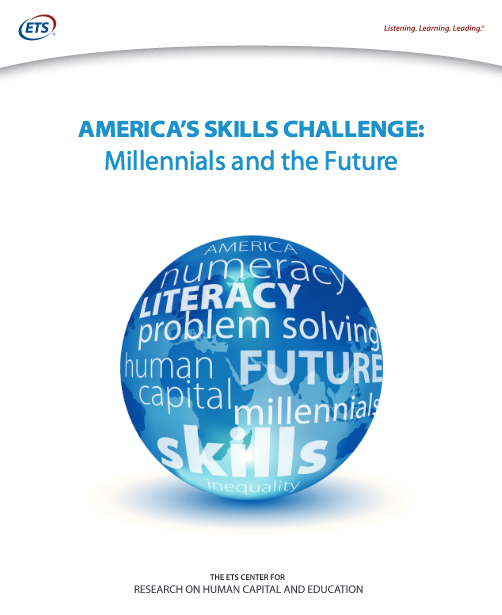
Another study released in 2015 should justify concerns about the news literacy of the current and coming digital generations: “America’s Skills Challenge: Millennials and the Future,” published by the Educational Testing Service’s Center for Research on Human Capital and Education. It found that young adults in the United States fall short of Millennials in other developed countries when it comes to the skills employers want most: literacy, practical math, and problem-solving in technology-rich environments. The study also found that the U.S. Millennials lagged behind other age groups within America itself. This is in a context in which 43 percent of Americans have earned college degrees, and 90 percent of Millennials now own a smartphone.

Equally troubling is that these findings represent a decrease in literacy and numeracy skills for U.S. adults when compared with results from previous adult surveys… In literacy, U.S. Millennials scored lower than 15 of the 22 participating countries. Only Millennials in Spain and Italy had lower scores.

The ETS study defined literacy as “the ability to understand, evaluate, use, and engage with written text to participate in society, to achieve one’s goals, and to develop one’s knowledge and potential.”

—Scott MacLeod

French Press: Mon Dieu!

France’s crise de la presse has no end in sight. Like almost everywhere, France’s print newspapers are grappling with declining sales, slumping ad revenues, and the challenges posed by digital media—how to join the digital revolution, or be crushed by it.

WWD has an interview with Francis Morel, CEO of France’s Les Echo Group, that gives a glimpse into the boardroom forces driving change in the French media. Among those forces: the takeover of French newspapers by conglomerates with no experience in journalism or professional stake in a free press; a trend toward boutique products like weekend magazines to attract elite readers and advertisers who want to reach them; and a determination to exploit marquee newspaper brands to develop consulting units and other sidelines.

morel-photo

Morel reports that such services could soon represent almost half of the business at Les Echos, which began publishing as France’s first daily financial newspaper in 1908:

There are always activities to develop to complement the main business of media. We launched Les Echos Solutions in June with services ranging from crowdfunding to market studies and incubators for start-up companies. We are developing a publishing arm for companies with a separate staff. Services will represent one-third of the group sales in 2016. Down the road, they could be up to 45 percent of Les Echos’ business. We define ourselves as “the first media outlet for information and services,” which makes us stand out. On the services front, I think we are at the forefront.

Les Echos is just another case of how French journalists find themselves entwined with conglomerates. The paper was closely held by the Schreiber family and then the Beytout family for eight decades before being sold to Britain’s Pearson PLC, itself a publishing and education company. In 2007, Pearson sold it to LVMH, the French luxury goods conglomerate focused on brands like Louis Vuitton, Christian Dior, and Moët & Chandon. Under Morel, Les Echos Group is now about to take ownership of two more French dailies, Le Parisien and its national counterpart, Aujourd’hui en France. That will put Les Echos Group in the top rank of French mainstream press, along with Le Monde and Le Figaro.

The marriage of journalists and conglomerates has not been a happy one. Shortly after the LVMH acquisition of Les Echos, editor Erik Israelewicz resigned over alleged editorial interference, and his staff went on strike to insist on editorial independence. Similar tensions arose in 2010 when a trio of French tycoons took control of Le Monde: Matthieu Pigasse, Pierre Bergé, and Xavier Niel. Since then, the paper has gone through five chief editors. (The trio, meanwhile, has acquired Le Nouvel Observateur, now simply L’Obs, a leading French newsweekly). Le Figaro, another French newspaper of record, is owned by the Dassault Group, known for its aerospace business in Mirage fighter bombers and other military aircraft.

libe

Critics accuse the French (and their labor unions) of being resistant to change. Where independent journalism is at stake, that may not be a bad thing at all. Last year journalists at Libération went on strike against a plan by its shareholders led by chairman Édouard de Rothschild (38.6 percent share) to “save” the paper—besides the usual staff cutbacks, the plan would turn the newspaper’s headquarters into a cultural center and reinvent the paper itself as a social network. Journalists at Libération, which was founded by philosopher Jean-Paul Sartre after the 1968 student and worker upheavals in France, explained their walkout with the front-page headline:

WE ARE A NEWSPAPER not a restaurant, not social media, not a TV studio, not a bar, not a startup incubator…

—Scott MacLeod

Vacating the Tower of Truth

We all know too well how the technology-driven disruption of the news business has led newspapers to slash their staffs—nearly 23,500 jobs (out of 56,400) at U.S. daily newspapers since 2001. David Uberti has a neat follow-up piece in the September/October 2015 Columbia Journalism Review—on the demise of America’s great newspaper buildings. (See a related piece by Tim Adams in the Guardian.)

newspaper buildings

Some of the landmark edifices were actually destroyed once journalists had been re-located to less expensive digs—One Herald Plaza, the Miami Herald headquarters on Biscayne Bay since 1963, pictured here, was torn down last year by the property’s new owner, a Malaysian casino operator. The art deco Inquirer Building, home to the Philadelphia Inquirer for 87 years, nicknamed the “Tower of Truth,” was purchased in 2011 by a property developer who wants to turn it into a hotel. Symbolizing the struggles of the Inky, which had been sold five times in six years, the remaining staff moved to smaller premises a year later. Other papers that vacated historic sites in recent years include the Detroit News and Detroit Free Press, Atlanta Journal-Constitution, Cleveland’s Plain Dealer, and Chicago Sun-Times, among others.

Uberti’s CJR cover story nicely captures the nostalgia for the pre-digital newspaper trade. He quotes the late journalist Al Martinez’s 2007 reflection on his old Oakland Tribune newsroom:

We were a brotherhood of young lions back then, working hard through a half-dozen deadlines a day and drinking hard. We did it, we told ourselves, for the people’s right to know, and affixed it like a knight’s pennant to the end of a spear.

But Uberti’s piece, headlined “Why the sale of old newspaper buildings isn’t all bad,” points out that the fading businesses can use the cash to pay down debt or reinvest in new products. And there’s more. He writes:

After the Inquirer departed the Tower of Truth, Inga Saffron, the newspaper’s architecture critic, was optimistic that it could forge a new identity elsewhere. “Making our home in a newspaper building froze us psychologically in history, and kept us from interacting physically in the city,” she wrote in a 2012 Inquirer column. “The future for all media is an interactive one.” In that environment, she added the next year in a New Republic piece, “the most valuable real estate is online.”

Such new offices certainly won’t solve newspaper companies’ long-term financial problems. But they’re a symbolic step forward into the unknown, an acknowledgement that there’s no going back to what came before, however glorious it was. The resulting psychological benefits can’t be overstated, especially for the younger generation on whose shoulders the fate of journalism rests. If the companies that formerly produced only newspapers have any chance of survival, they will need that energy—not the baggage that accompanied vaunted historical headquarters.

This job isn’t as noble as it seems, most journalists would admit, but it’s as noble as any job is going to get. The real reason it’s so difficult to let go to of aging buildings is that they’re relics of an era in which journalism was simply a calling, not a struggling business with corporate ownership, quarterly earnings reports, not enough money coming in, and too many journalists going out. The physical structures remind us of a time when those in our profession felt in control of their own destiny.

—Scott MacLeod

Innovating at the New York Times

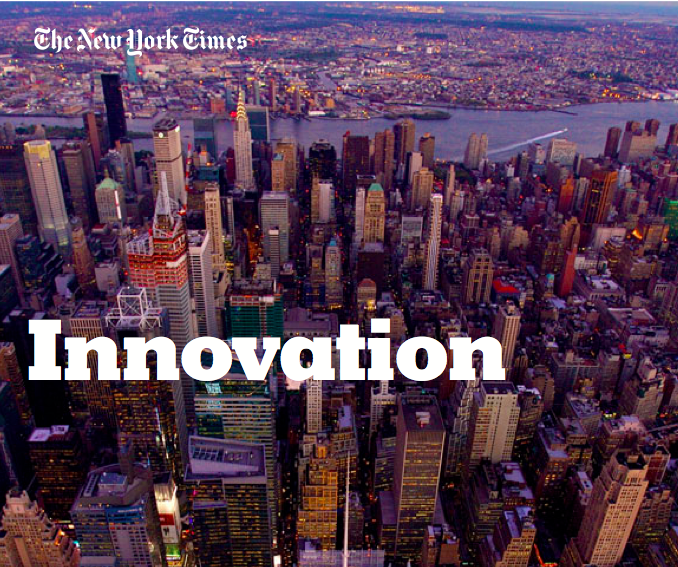
In March 2014, the New York Times produced a report titled “Innovation,” a fascinating internal study of the American news business in general and the Times in particular. The study (soon leaked on the Internet—download it here) candidly admitted that the paper’s readership was falling—including its audience online and on smartphone apps—and something needed to be done about it as a matter of urgency.

innovation

The fate of the New York Times is a concern for all of us. Whatever its flaws, the Times is the best newspaper in the world—if we judge it on the basis of the depth, breadth, and excellence of its reporting and commentary. Countless successful online media organizations are what they are today because they aggregate or pinch New York Times journalism. American democracy is suffering from the demise of legacy media institutions, and the fall of the Times would be an unbearable blow—an end to quality journalism as Americans know it.

The Innovation report made various recommendations to Times executives under the headings of “Growing Our Audience” and “Strengthening Our Newsroom.” One of the recommendations was for a belated but nonetheless revolutionary step: “Map a strategy to make the newsroom a truly digital-first organization.” Note the words: Digital-First.

Lately, some observers have been assessing how the Times is doing since the Innovation report was issued. A few views: here, here and here.

The consensus seems to be that the paper is taking the recommendations very seriously. Arthur Gregg Sultzburger, who led the Innovation team and is the son of the Times’ publisher, has spent the past year heading the Newsroom Strategy team on digital transformation. He has now been promoted to associate editor of the Times.

—Scott MacLeod

The Scoop on HuffPost Arabi

huffpostarabi

HuffPost Arabi is off to a surprisingly rocky start. There was a good rundown of the problems recently on Brian Whitaker’s Al-Bab blog:

DIDN’T Arianna Huffington realise what she was getting into when she decided to launch HuffPost Arabi? In the first three weeks it has certainly been attracting attention, but mostly of the wrong sort.

The new Arabic-language website was born amid a show of bravado from Ms Huffington. Avoiding “any kind of censorship and control,” she said, would be “absolutely key”. For that reason it would be operating from London and Istanbul rather than any of the Arab countries, and would pursue stories “relentlessly”.

She also vowed to back the website’s writers to the hilt. “We will support [contributors] in every way,” she said. “Anyone persecuted for opinions published on the site” would be given legal funding and “extensive coverage” across other sections of Huffington Post.

But promising that kind of blanket support to largely unknown writers for as-yet-unwritten articles was inviting trouble – especially considering that the editorial director of Huffington Post’s Arabic offshoot is a Qatari known for his pro-Islamist stance and its Egyptian editor-in-chief is a self-declared member of the Muslim Brotherhood.

Read Whitaker’s entire article here. Among the problems he cites: an article by an Egyptian writer that castigated gays that Huffpost Arabi found it necessary to delete; a rosy tribute to the late Taliban leader Mullah Omar by the former Al Jazeera correspondent in Afghanistan; and an essay by an Algerian researcher denouncing selfie photographs as “sick.”

This is what the Independent had to say when HuffPost Arabi launched in July. Check out Arianna Huffington’s launch announcement.

Huffington spoke about HuffPost Arabi and her ever expanding international reach in an interview with me for the Cairo Review of Global Affairs Winter 2015 edition.

—Scott MacLeod

Digital Riptide Continues

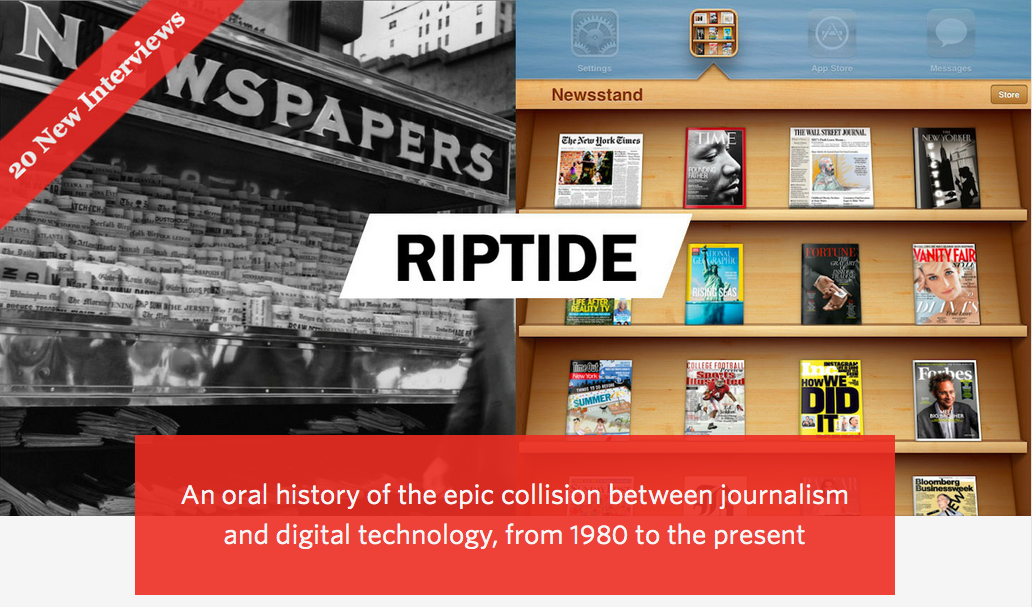
The report from the Shorenstein Center on the transformation of the American news media was aptly titled “Riptide: What Really Happened to the News Business.”

The oral history published in 2013 is still worth a read (and a listen—see below), especially considering the inside knowledge of the report’s authors. John Huey was editor-in-chief of Time Inc. from 2006-2012 during years of digital upheaval in the Time Inc. stable of publications. Paul Sagan was president and editor of new media at Time Inc. from 1995-1997 when American media first started catching on to the threat/opportunity of digital. Martin Nisenholtz was the founding leader of nytimes.com in 1995 and chief executive of New York Times Digital from 1995-2005.

But Riptide is not a static report, it is an ongoing project based on the website www.digitalriptide.org. The website is an amazing repository of information, including videos and transcripts of interviews done for the project and documents such as internal memos about the digital transition written by industry leaders.

digital riptide-blog

An excerpt from Riptide’s Introduction is below, but download the 2013 full report here.

For most of the 20th century, any list of America’s wealthiest families would include quite a few publishers generally considered to be in the “news business”: the Hearsts, the Pulitzers, the Sulzbergers, the Grahams, the Chandlers, the Coxes, the Knights, the Ridders, the Luces, the Bancrofts—a tribute to the fabulous business model that once delivered the country its news. While many of those families remain wealthy today, their historic core businesses are in steep decline (or worse), and their position at the top of the wealth builders has long since been eclipsed by people with other names: Gates, Page and Brin and Schmidt, Zuckerberg, Bezos, Case, and Jobs—builders of digital platforms that, while not specifically targeted at the “news business,” have nonetheless severely disrupted it.

Reasonable people can—and do—debate whether the replacement of legacy media by new forms of information gathering and distribution—including citizen journalism and smartphone photojournalism, crowdsourcing, universal access to data and, of course, a world awash in Twitter feeds—makes democracy more or less vulnerable. Usually the argument is reduced to a couple of symbolic questions: Who’s going to pay for the Baghdad bureau? Who’s going to replace the watchdog function at city hall traditionally provided by healthy metro newspapers?

Not everybody is a fan of the study. Some critics complained that the insider perspective of the authors blinded them to some realities of the digital revolution. For example, they noted that of the 61 movers and shakers initially interviewed for the study, five were (white) women, two were men of color, and zero were women of color.

The authors retort that their study is a work in progress, that 20 new interviews have been added (there are now 12 women listed as interviewees), and that they welcome suggestions for further voices or topics. Email: shorenstein_center@hks.harvard.edu.

—Scott MacLeod

Superheroes to the Rescue

To see a brighter future for journalism, there are two people you should know: Christopher Callahan and Eric Newton.

Callahan is the visionary dean of the Walter Cronkite School of Journalism and Mass Communication. In the last 10 years he’s turned Cronkite into perhaps the best journalism program in the United States. His record of achievement is mind-blowing, but here are just a few highlights from his ASU biography:

Callahan has brought to the Cronkite School the Donald W. Reynolds National Center for Business Journalism, the Carnegie-Knight News21 digital journalism initiative, the Society of American Business Editors and Writers and the Hubert H. Humphrey Fellowship program for international journalists.

He spearheaded the creation of Cronkite News Service, (a daily statewide news service providing content on all platforms to news organizations), the New Media Innovation Lab (a research and development lab), Cronkite NewsWatch (a nightly newscast that reaches more than 1 million households on PBS), the Knight Center for Digital Media Entrepreneurship (where students develop their own digital media products), Cronkite News (a daily news website focusing on statewide issues) and the Cronkite New Media Academy (which provides multimedia training to professional journalists).

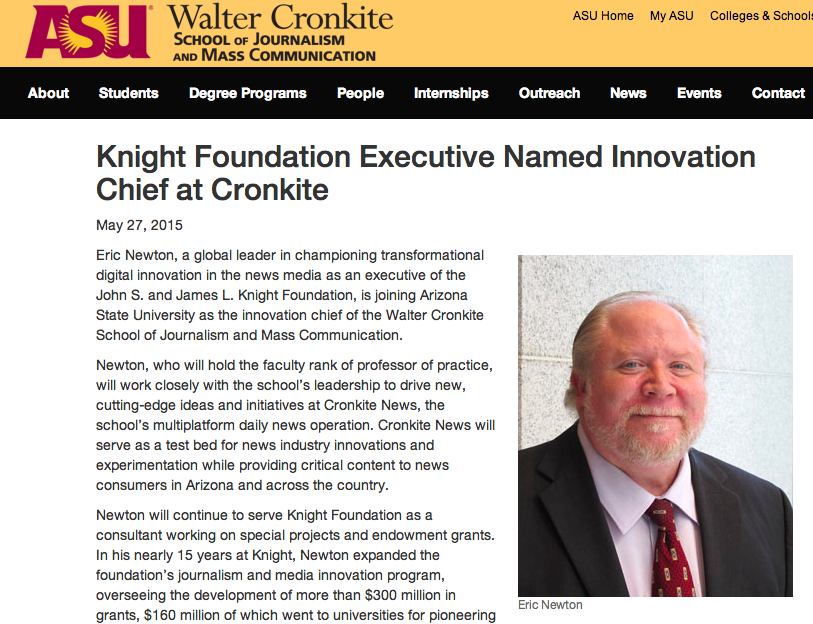
Now Newton has joined Callahan’s team as the Cronkite school’s innovation chief. According to ASU’s announcement, Newton “will work closely with the school’s leadership to drive new, cutting-edge ideas and initiatives at Cronkite News, the school’s multiplatform daily news operation. Cronkite News will serve as a test bed for news industry innovations and experimentation while providing critical content to news consumers in Arizona and across the country.”

asu-newton

Newton comes to Cronkite after an illustrious journalism career including the last 15 years at the John S. and James L. Knight Foundation, where he pioneered efforts to, among other things, reform journalism education and bring it into the digital age. His work led to the 2011 Carnegie-Knight Initiative on the Future of Journalism Education, an effort to advance journalism by reinvigorating journalism schools and programs.

Newton knows his stuff. Before joining Knight, he was the founding managing editor of the Newseum in Washington, D.C., and before that was city editor, assistant managing editor and managing editor of the Oakland Tribune. He memorably pinpointed the challenges we face in journalism and journalism education in a talk about the Carnegie-Knight initiative at Middle Tennessee State University in 2013:

We had entered the digital age, and it was a time of plenty and of paradox. More readers, less advertising revenue. More writing, less journalism. More information, less meaning. More opportunity, less predictability.

One point was clear. All institutions, including academia, suddenly were out of date. That created more questions than we had answers. Could universities embrace continuous change? Might journalism and mass communication education have a new role to play in the future of news?

Seven years later, I can tell you the answer is yes. Universities can help lead the way through the era of “creative destruction.” But only if they are willing to destroy and recreate themselves.

And that’s the way it is (sorry, couldn’t resist the Uncle Walter pun), a duo battling like superheros against the odds so that journalism (and journalism education) may live to see another day.

—Scott MacLeod

The Journalists’ Bard

It’s a grand, grand caper. You get to leave, go talk to strangers, ask them anything, come back, type up their stories, edit the tape. That’s not gonna retire your loans as quickly as it should, and it’s not going to turn you into a person who’s worried about what kind of car they should buy, but that’s kind of as it should be. I mean, it beats working.

—David Carr (1956-2015)

That’s from David Carr’s commencement address in 2014 at the University of California, Berkeley, Graduate School of Journalism, a paean to his profession that manages to be sentimental and hard-boiled at the same time. As the Media Equation columnist and culture writer for the New York Times, Carr captured the zeitgeist of a world turned upside down by the Internet better than anyone.

“David was a bard for journalists because he figured out how to connect our past with our present,” David Leonhardt wrote in an appreciation in the Times. “He venerated old-fashioned reporting and yet described today as a ‘golden age’ for journalists.”

Carr collapsed in the Times’ newsroom and later died of complications from lung cancer last February, at age 58. He lives on; for example, here in the video of his Berkeley commencement address, as well as in Page One, Andrew Rossi’s great 2011 documentary about the New York Times struggling with the transformation of the news business.

—Scott MacLeod