
Crackdown on Anonymous Sources
Three cheers for the move by the New York Times to tighten up the use of anonymous sources in its reporting.
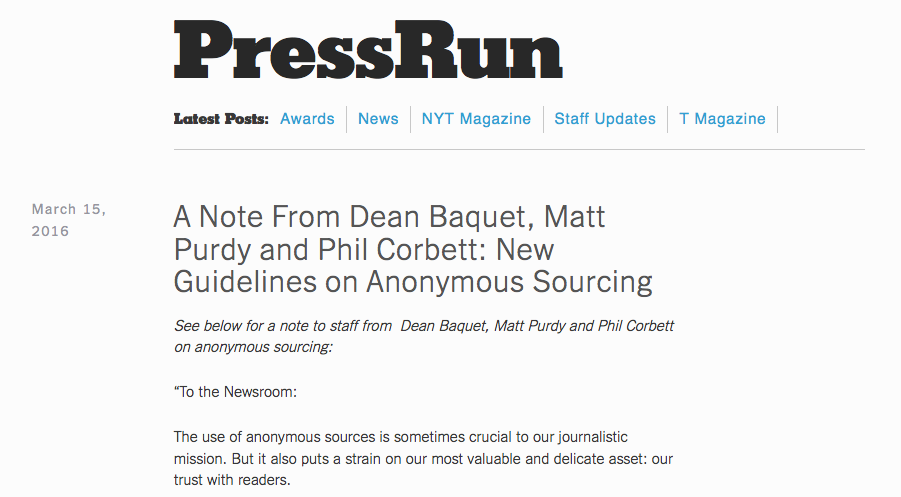
In a memo to the Times’ staff on March 15, Executive Editor Dean Baquet, Deputy Executive Editor Matt Purdy, and Standards Editor Philip Corbett noted that while sometimes crucial to the journalistic mission, the use of anonymous sources “also puts a strain on our most valuable and delicate asset: our trust with readers. … [R]eaders question whether anonymity allows unnamed people to skew a story in favor of their own agenda. In rare cases, we have published information from anonymous sources without enough questions or skepticism—and it has turned out to be wrong.”
The Times stylebook has long provided strong and clear criteria governing anonymous sourcing, but the memo introduced three new procedures and a reminder. When anonymous sources are the primary news element in a story, the story must get a signoff from one of the newspaper’s three top editors. Other use of anonymous sources must have the approval of the relevant department head or deputy. Direct quotes from anonymous sources will be permitted only rarely. And, finally, the memo reminds reporters that at least one Times editor must know the specific identity of any anonymous sources before publication.
The memo did not say so, but Times Public Editor Margaret Sullivan suggested the crackdown was the result of two embarrassing errors in front page stories over a six-month period in 2015. See her reviews of those mistakes here and here.
Sullivan has been campaigning in the newsroom for tighter control over anonymous sources. In 2014, she launched a special section of her Public Editor’s Journal called Anonywatch to track nameless quotations in the Times.
Here’s the full memo
To the Newsroom:
The use of anonymous sources is sometimes crucial to our journalistic mission. But it also puts a strain on our most valuable and delicate asset: our trust with readers.
At best, granting anonymity allows us to reveal the atrocities of terror groups, government abuses or other situations where sources may risk their lives, freedom or careers by talking to us. In sensitive areas like national security reporting, it can be unavoidable. But in other cases, readers question whether anonymity allows unnamed people to skew a story in favor of their own agenda. In rare cases, we have published information from anonymous sources without enough questions or skepticism—and it has turned out to be wrong.
The use of anonymous sources presents the greatest risk in our most consequential, exclusive stories. But the appearance of anonymous sources in routine government and political stories, as well as many other enterprise and feature stories, also tests our credibility with readers. They routinely cite anonymous sources as one of their greatest concerns about The Times’s journalism.
After consulting with a number of our most experienced reporters and editors, we have decided to take several steps to raise the bar and provide added scrutiny for our use of anonymous sources. These new guidelines require top editors to approve the use of anonymity. But it is incumbent on everyone producing journalism throughout the newsroom to share the responsibility.
Our basic, longstanding criteria remain unchanged: Anonymity should be, as our stylebook entry says, “a last resort, for situations in which The Times could not otherwise publish information it considers newsworthy and reliable.” That standard should be taken seriously and applied rigorously. Material from anonymous sources should be “information,” not just spin or speculation. It should be “newsworthy,” not just color or embellishment. And it should be information we consider “reliable”—ideally because we have additional corroboration, or because we know that the source has first-hand, direct knowledge. Our level of skepticism should be high and our questions pointed. Without a named source, readers may see The Times as vouching for the information unequivocally—or, worse, as carrying water for someone else’s agenda. As far as possible, we should explain the source’s motivation and how he or she knows the information.
We recognize that in today’s hypercompetitive news environment, the tighter guidelines below inevitably mean that we will occasionally be beaten on a story. We have no intention of reducing our urgency in getting news to our readers. But we are prepared to pay the price of losing an occasional scoop in order to protect our precious credibility.
This is not an easy balance to strike, and these new guidelines may be just the starting point. We will review these steps in the coming months and make adjustments if necessary. For now, we want to adopt these new procedures, starting immediately in all departments:
1. Special rules apply when the lead of a story—that is, the primary news element—is based entirely on one or more anonymous sources.
Any such story must be presented in advance by the relevant department head to Dean, Matt or Susan. They should be told explicitly why their approval is being sought—that is, the story’s main news element depends on anonymous sourcing. The department head should be prepared to discuss the details of the sourcing and other reporting, including the identity of the source, if asked.
This conversation or email exchange should not be part of a routine discussion of multiple stories. Sending a batch of summaries or simply passing along a copy without comment is not enough. This should be a dedicated conversation, focusing entirely on the sourcing issue of this one story.
If it sounds as though this will slow down the process—that’s part of the point. A story that hangs entirely on anonymous sourcing should always get special scrutiny. If, for any reason, you have not received specific approval, the story should be held.
On rare occasions when all three of those editors will be unavailable, they will designate Phil or another masthead editor to grant these approvals. A note on the story should specify which masthead editor approved the sourcing.
2. Every other use of anonymous sourcing anywhere in any story must be personally approved in advance by the department head or deputy.
A note on the story should indicate that the sourcing has been approved, and by whom. Slot editors, copy editors and producers should not publish a story with any anonymous sourcing that does not have a note indicating that the department head or deputy has approved the sourcing.
3. Direct quotes from anonymous sources will be allowed only in rare instances and with the approval of the department head or deputy. Such quotes are generally used to add color—but by definition, merely adding color does not normally clear the bar of newsworthiness that justifies anonymous sourcing. If the substance of the quote is newsworthy, it can be paraphrased, and must be approved under the procedures above.
Sources who demand anonymity give up the opportunity to have their speculation or interpretation reflected in our stories, and such quotes will no longer be allowed except in the rare instances when the direct quote is pivotal to a story. Other exceptions might include ordinary individuals who are sharing personal details in difficult circumstances and whose voices are worth capturing—for instance, immigrants discussing their ordeal with smugglers, or patients sharing their medical histories. In all these cases, direct quotes from anonymous sources must be approved by the department head or deputy.
4. As a reminder, it continues to be a hard-and-fast rule that at least one editor must know the specific identity of any anonymous source before publication.
Departments should set up regular procedures to make sure this rule is followed consistently.
—Scott MacLeod
 media chinwag