media chinwag

Musings on Journalism in the Online Age

Tag: New York Times

Crackdown on Anonymous Sources

Three cheers for the move by the New York Times to tighten up the use of anonymous sources in its reporting.
newrules

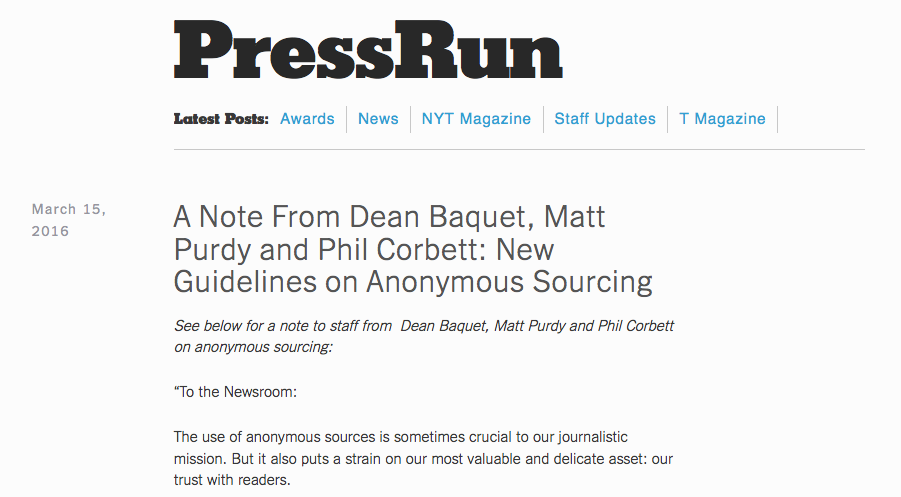
In a memo to the Times’ staff on March 15, Executive Editor Dean Baquet, Deputy Executive Editor Matt Purdy, and Standards Editor Philip Corbett noted that while sometimes crucial to the journalistic mission, the use of anonymous sources “also puts a strain on our most valuable and delicate asset: our trust with readers. … [R]eaders question whether anonymity allows unnamed people to skew a story in favor of their own agenda. In rare cases, we have published information from anonymous sources without enough questions or skepticism—and it has turned out to be wrong.”

The Times stylebook has long provided strong and clear criteria governing anonymous sourcing, but the memo introduced three new procedures and a reminder. When anonymous sources are the primary news element in a story, the story must get a signoff from one of the newspaper’s three top editors. Other use of anonymous sources must have the approval of the relevant department head or deputy. Direct quotes from anonymous sources will be permitted only rarely. And, finally, the memo reminds reporters that at least one Times editor must know the specific identity of any anonymous sources before publication.

The memo did not say so, but Times Public Editor Margaret Sullivan suggested the crackdown was the result of two embarrassing errors in front page stories over a six-month period in 2015. See her reviews of those mistakes here and here.

Sullivan has been campaigning in the newsroom for tighter control over anonymous sources. In 2014, she launched a special section of her Public Editor’s Journal called Anonywatch to track nameless quotations in the Times.

Here’s the full memo

To the Newsroom:

The use of anonymous sources is sometimes crucial to our journalistic mission. But it also puts a strain on our most valuable and delicate asset: our trust with readers.

At best, granting anonymity allows us to reveal the atrocities of terror groups, government abuses or other situations where sources may risk their lives, freedom or careers by talking to us. In sensitive areas like national security reporting, it can be unavoidable. But in other cases, readers question whether anonymity allows unnamed people to skew a story in favor of their own agenda. In rare cases, we have published information from anonymous sources without enough questions or skepticism—and it has turned out to be wrong.

The use of anonymous sources presents the greatest risk in our most consequential, exclusive stories. But the appearance of anonymous sources in routine government and political stories, as well as many other enterprise and feature stories, also tests our credibility with readers. They routinely cite anonymous sources as one of their greatest concerns about The Times’s journalism.

After consulting with a number of our most experienced reporters and editors, we have decided to take several steps to raise the bar and provide added scrutiny for our use of anonymous sources. These new guidelines require top editors to approve the use of anonymity. But it is incumbent on everyone producing journalism throughout the newsroom to share the responsibility.

Our basic, longstanding criteria remain unchanged: Anonymity should be, as our stylebook entry says, “a last resort, for situations in which The Times could not otherwise publish information it considers newsworthy and reliable.” That standard should be taken seriously and applied rigorously. Material from anonymous sources should be “information,” not just spin or speculation. It should be “newsworthy,” not just color or embellishment. And it should be information we consider “reliable”—ideally because we have additional corroboration, or because we know that the source has first-hand, direct knowledge. Our level of skepticism should be high and our questions pointed. Without a named source, readers may see The Times as vouching for the information unequivocally—or, worse, as carrying water for someone else’s agenda. As far as possible, we should explain the source’s motivation and how he or she knows the information.

We recognize that in today’s hypercompetitive news environment, the tighter guidelines below inevitably mean that we will occasionally be beaten on a story. We have no intention of reducing our urgency in getting news to our readers. But we are prepared to pay the price of losing an occasional scoop in order to protect our precious credibility.

This is not an easy balance to strike, and these new guidelines may be just the starting point. We will review these steps in the coming months and make adjustments if necessary. For now, we want to adopt these new procedures, starting immediately in all departments:

1. Special rules apply when the lead of a story—that is, the primary news element—is based entirely on one or more anonymous sources.

Any such story must be presented in advance by the relevant department head to Dean, Matt or Susan. They should be told explicitly why their approval is being sought—that is, the story’s main news element depends on anonymous sourcing. The department head should be prepared to discuss the details of the sourcing and other reporting, including the identity of the source, if asked.

This conversation or email exchange should not be part of a routine discussion of multiple stories. Sending a batch of summaries or simply passing along a copy without comment is not enough. This should be a dedicated conversation, focusing entirely on the sourcing issue of this one story.

If it sounds as though this will slow down the process—that’s part of the point. A story that hangs entirely on anonymous sourcing should always get special scrutiny. If, for any reason, you have not received specific approval, the story should be held.

On rare occasions when all three of those editors will be unavailable, they will designate Phil or another masthead editor to grant these approvals. A note on the story should specify which masthead editor approved the sourcing.

2. Every other use of anonymous sourcing anywhere in any story must be personally approved in advance by the department head or deputy.

A note on the story should indicate that the sourcing has been approved, and by whom. Slot editors, copy editors and producers should not publish a story with any anonymous sourcing that does not have a note indicating that the department head or deputy has approved the sourcing.

3. Direct quotes from anonymous sources will be allowed only in rare instances and with the approval of the department head or deputy. Such quotes are generally used to add color—but by definition, merely adding color does not normally clear the bar of newsworthiness that justifies anonymous sourcing. If the substance of the quote is newsworthy, it can be paraphrased, and must be approved under the procedures above.

Sources who demand anonymity give up the opportunity to have their speculation or interpretation reflected in our stories, and such quotes will no longer be allowed except in the rare instances when the direct quote is pivotal to a story. Other exceptions might include ordinary individuals who are sharing personal details in difficult circumstances and whose voices are worth capturing—for instance, immigrants discussing their ordeal with smugglers, or patients sharing their medical histories. In all these cases, direct quotes from anonymous sources must be approved by the department head or deputy.

4. As a reminder, it continues to be a hard-and-fast rule that at least one editor must know the specific identity of any anonymous source before publication.

Departments should set up regular procedures to make sure this rule is followed consistently.

—Scott MacLeod

The Intercept, Two Years On

Adversarial muckrakers + civic-minded billionaire = a whole new world

That was the sub-headline on a Columbia Journalism Review article on October 17, 2013. It perfectly summed up the excitement many of us felt about the announcement that billionaire eBay founder Pierre Omidyar and national security journalist Glenn Greenwald were getting into the journalism business together. But, alas, the partnership still seems to be very far from reaching its objectives and potential.

intercept

By February 2014, Omidyar and Greenwald, with a barebones staff, had launched The Intercept. According to its mission statement, The Intercept is “dedicated to producing fearless, adversarial journalism. We believe journalism should bring transparency and accountability to powerful governmental and corporate institutions, and our journalists have the editorial freedom and legal support to pursue this mission.”

Over the past two years, The Intercept has undoubtedly proved to be an important new player in American journalism. It has hired stellar journalists such as—in addition to Greenwald—Laura Poitras, Jeremy Scahill, and Peter Maass. It has been a relentless watchdog on powerful people and institutions, initially as a platform for Greenwald’s ground-breaking reporting on the National Security Agency based on leaked documents from Edward Snowden.

Yet, by The Intercept’s own reckoning, the launch of the publication was severely hampered by the management style of First Look Media, the parent company Omidyar created for an envisioned $250 million investment in journalistic projects.

In June 2014, Greenwald, Poitras, Scahill and Matt Taibbi—who was hired to start a separate First Look Media publication called Racket—wrote a letter to Omidyar complaining that budgetary and personnel restrictions were jeopardizing the whole enterprise. The Intercept, already up and running with big-name journalists, managed to work out some of the kinks with First Look. But Taibbi left the company to return to Rolling Stone magazine, and First Look shut down Racket before its launch.

The recent scandal involving reporter Juan Thompson indicates that The Intercept’s organizational problems are far from over. And these problems are beginning to infect The Intercept’s credibility.

In “A Note to Readers” on February 2, 2016, Editor in Chief Betsy Reed announced the firing of Thompson, who had covered race and criminal justice issues for The Intercept since November 2014. An internal investigation had revealed that Thompson fabricated quotes, deceived editors, and lied about his reporting methods.

One of the egregious examples was a Thompson story dated June 19, 2015, about 21-year-old Dylann Roof, who slaughtered nine African Americans in a church in Charleston, South Carolina two days earlier. The article quoted Scott Roof, who was identified as Roof’s cousin, saying that Roof went “over the edge” when a girl he liked started dating an African American man. The Intercept’s internal investigation, which included speaking with two members of the Roof family, said the family did not know of such a cousin.

In her note, Reed accepted responsibility for the Thompson affair, apologizing to the subjects of the stories, to people who were falsely quoted, and to The Intercept’s readers. “The best way we can see to maintain the trust of readers,” she wrote, “is to acknowledge and correct these mistakes, and to focus on producing journalism we are proud of.”

That may not be enough to maintain the trust of The Intercept’s readers. The Thompson fabrications amount to an institutional scandal of great proportions, particularly for an organization that prides itself on reporting highly sensitive stories based on anonymous sources.

The Intercept should follow through with a full (and preferably independent) investigation into Thompson’s career and work at the publication. The review should not only cover Thompson’s reporting methods and deceptions, but the editorial process that enabled him to get away with the fabrications. Precedents for such accountability have been set by other publications, notably the New York Times in the Jayson Blair scandal, and Rolling Stone in the case of its discredited story about a vicious gang rape at a college fraternity house.

Also curious is The Intercept’s decision to keep Thompson’s 40-some stories for the publication as well as his biography on its website. The Dylann Roof story is labeled “Retracted” with an editor’s note explaining why, and four other stories are labeled “Corrected” with similar editor’s notes.

However well intended, this approach does nothing to restore the breach of trust that The Intercept has created with its readers. It leaves the impression that everything is more or less okay, except for a few errors here and there by a lone reporter that have now been “corrected.” It leaves the mea culpa seeming half-hearted.

Perhaps a better idea is for The Intercept’s homepage to display a prominent hyperlinked “Correcting the Record” box, where readers would be taken to a full report on the affair and an account of measures being taken to prevent future breakdowns in the editorial process.

If Thompson’s bio is to remain, it should  be accompanied by text clearly explaining his role in the breach of trust. His journalism should be transparently removed from the website, or kept in a special section devoted entirely to the scandal. Readers can hardly have any confidence in his articles after his own editor in chief stated that “Thompson went to great lengths to deceive his editors, creating an email account to impersonate a source and lying about his reporting methods.”

After all its organizational problems, New Look Media is well advised to get its act together. This is an outfit that was flung together too quickly, without regard for the importance of creating a foundational institutional culture suited to the work of journalism. Omidyar  formed the partnership with Greenwald within a few weeks of meeting him for the first time, without even discussing roles and responsibilities. Omidyar’s idea resembled what New York University’s Jay Rosen calls the “personal franchise model” of assembling star journalists and supporting them.

The Intercept itself diagnosed the problem with this idea, in a remarkable article it published in October 30, 2014 about the turmoil within First Look Media that led to Matt Taibbi’s exit:

First Look and the editorial staff it hired quickly learned that it is much easier to talk about such high-minded, abstract principles than it is to construct an organization around them. The decision to create a new editorial model left space for confusion, differing perspectives, and misaligned expectations.

—Scott MacLeod

Covering the Hate Beat

A notable feature of the 2016 race for the White House has been the free flowing comments of some Republican candidates against economic migrants and political refugees and, by association, against the Latino and Muslim communities. The comments go beyond anti-immigration rhetoric and cross the line into the realm of hate speech.

hatespeech

Businessman Donald Trump led the way in his presidential announcement speech on June 16 by describing Mexican immigrants as criminals, drug smugglers, and rapists. After the terrorist attacks in Paris on November 13, he redirected his venom toward Muslims. He called for a database to monitor Syrian refugees and possibly all American Muslims as well. Trump accompanied this view with a statement questioning the loyalty of American Muslims, claiming that immediately after the September 11 terrorist attack on Manhattan’s World Trade Center “thousands and thousands of people were cheering” across the river in Jersey City “where you have large Arab populations.”

Trump’s Islam-bashing actually started long before he became the leading contender for the Republican presidential nomination—he’s been at the top of the polls since June. He was one of the loudest voices in the United States pushing right-wing claims intended to smear President Barack Obama—that he was born in Kenya—which would disqualify him from occupying the presidency—and that he was a secret Muslim.

Ben Carson, an African-American neurosurgeon in the Republican race, chimed in that Muslims are unfit to be president of the United States because of their religious faith. Ted Cruz, a senator from Texas and another Republican candidate, called for banning refugees from Syria if they are Muslim, but letting Christians in. “There is no meaningful risk of Christians committing acts of terror,” he explained. Another contender, Senator Marco Rubio of Florida, echoed a threat by Trump to shut down U.S. mosques as venues inspiring radicalism. In the latest opinion survey, Trump, Rubio, Cruz, and Carson lead the Republican race with 36, 14, 12, and 10 percent support, respectively, among likely Republican primary voters.

To a great extent, American mainstream news media organizations, wittingly or otherwise, have propelled the hate speech. They have hyped the sound bites, replaying them in headline after headline and broadcast after broadcast, to the point that the comments have enabled the candidates to drive news coverage and thus dominate the campaign discourse. Moreover, too rarely are the comments characterized as hate speech, but are rather labeled as “controversial” or “provocative.” Here journalists are pursuing a false objectivity, eager to prove they are not biased for or against any candidate or party. They are also taking refuge in a false equivalency that treats comments defending or attacking Latino or Muslim communities as equally valid and acceptable political discourse.

Hate speech is broadly protected by the First Amendment, giving Trump and the other Republican candidates a constitutional right to make their odious comments. In Europe, they would need to be more careful. Britain’s Racial and Religious Hatred Act of 2006 makes it an offense to incite hatred against a group of people based on their religious beliefs. In France, even an icon such as Brigitte Bardot has been convicted and fined for inciting hatred with anti-Muslim comments, including: “My country, France, my homeland, my land is again invaded by an overpopulation of foreigners, especially Muslims.”

Nor in the United States is the right of free speech absolute. Incitement of violence, for example, is not fully protected—and there are reasons to believe that Trump’s remarks have incited violence. The cartoons mocking the Prophet Mohammed published by the Danish newspaper Jyllands-Posten became a cause célèbre for many free speech advocates, who argued that by definition free expression must include the right to spout offensive ideas. (The cartoons most certainly were a direct cause of the anti-Danish protests and riots that swept the Islamic World afterwards, with some 200 deaths.) In an aggressive campaign asserting such a right, the French satirical weekly Charlie Hebdo famously persisted in publishing insulting cartoons of the Prophet Mohammed. When Muslim extremists attacked the magazine’s offices and slaughtered 12 people last January, massive demonstrations erupted across France proclaiming “Je Suis Charlie,” ostensibly in defense of free speech.

These can be difficult issues, certainly for journalists, who see part of their calling as a mission to defend the right to a free press. Nobody should argue that the news media should ignore hate speech, least of all when it is spewed forth by public figures and even aspirants to the presidency. The question is how to cover it.

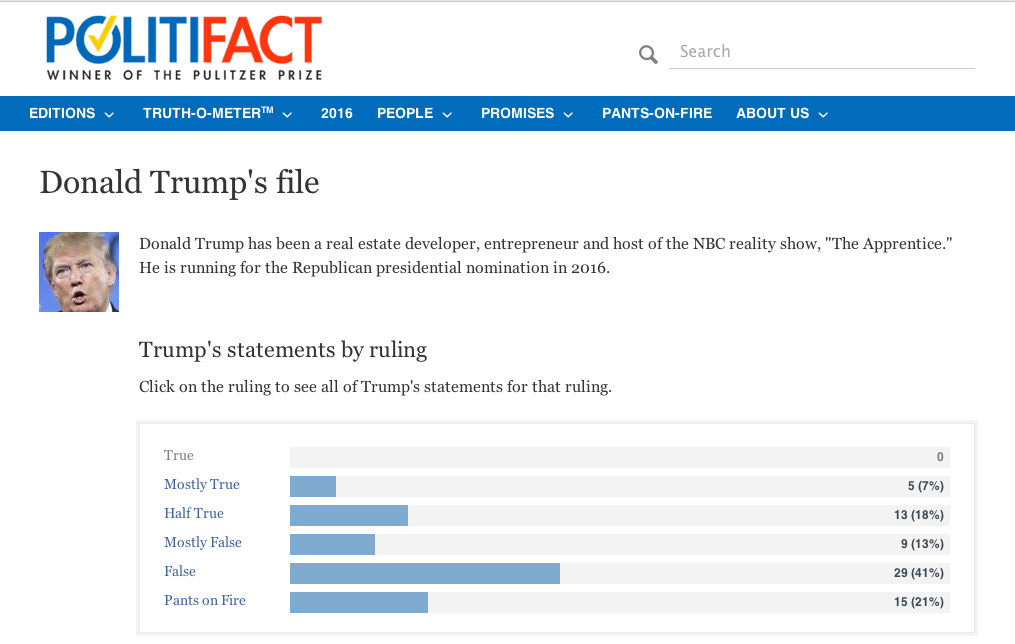
When journalists cover criticism of the hate-mongers, they provide readers and viewers with important alternative viewpoints. News media outlets have traditionally called out lies or provided context on their editorial and Op-Ed pages. Some news media and civil society organizations have institutionalized platforms that make fact checking a discrete service holding public figures accountable for the accuracy of their statements. The Washington Post, FactCheck.org, and PolitFact.com have done admirable work in exposing Trump’s untruths about Latinos and Muslims. In September, the New York Times carried a strongly worded editorial criticizing the Republican attack on Muslims.

But this is not enough, not in an era when the best intentions of the finest journalists are often drowned out by the deafening idiocy of “debates” on so many cable and satellite so-called news channels, or otherwise overwhelmed by social media chatter.

News executives and beat journalists alike need to take a long, hard look at how to define and treat hate speech in the digital media age. One of the principles of journalism is pursuit of the truth—and “truth” is not just dutifully recording and endlessly repeating the hate speech of politicians, but also providing background and perspective. Journalists have an important obligation to their societies to be responsible framers of the public discussion—but this is not accomplished when the endless repetition of the hateful sound bites overwhelms the few stories or editorials here and there that attempt to give critical context.

Broadly speaking, the American mainstream news media has failed miserably in its obligation to provide a comprehensive and proportional narrative of American life—including the lives and voices of ethnic and religious minorities. It should go without saying that Latino and Muslim communities and new immigrants—including the undocumented immigrants that Republicans are so fond of baiting—have made enormous positive contributions to the economic and cultural vitality of the United States. America, indeed, is a nation of immigrants. Yet, pack journalism’s obsession with sound bytes and easy headlines reinforces ignorance about minority communities and the issues around them.

There are a number of immediate steps that American editors and reporters can take to address hate speech. They can put the brakes on automatic, continuous, tabloid-style coverage that treats a politician spewing hate speech as if it was just Justin Bieber committing another act of adolescent mischief. Instead, they can provide their readers and viewers with thoughtful explorations and discussions that use universal human values, rather than the false objectivity and balance supposedly conferred by equal column inches and air time, as journalism’s frame of reference. American journalists can devote space to much fuller, more responsible coverage of communities upon which demagogues are apt to prey.

At the heart of the matter is the philosophical question of free speech. Without any hesitation, it should be practiced and defended at all costs. Whether one cites Supreme Court decisions or the law of common sense, it is clear that healthy societies are built upon the free flow of information and opinions. That is precisely why it is so important that journalists not abuse their right of free speech, or enable others to abuse it. Journalists need not scapegoat, defame, or humiliate our most vulnerable communities, or provide the megaphone for those who do, to prove that free speech is a value worth defending.

—Scott MacLeod

NYT: “Our Path Forward”

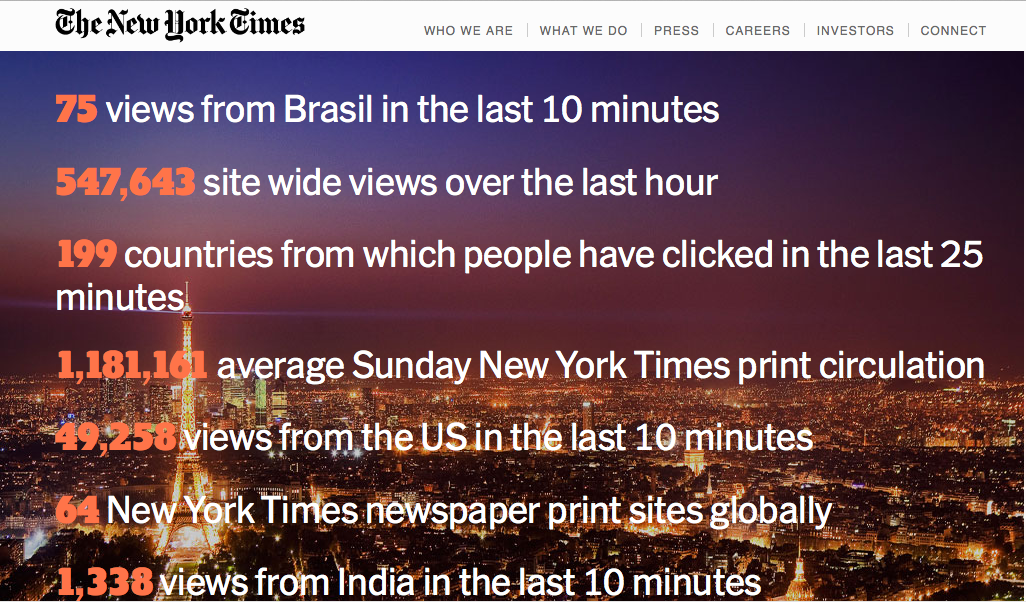
Its 96-page internal “Innovation” report in March 2014 called for a strategy to make the New York Times newsroom “a truly digital-first organization.” Last month, the strategy was unveiled, and it might rather be termed a “mobile-first” strategy.

Screen

Executive Editor Dean Baquet, Chairman and Publisher Arthur O. Sultzberger Jr., and eight other officials of the 164-year-old newspaper company declared in an 11-page memo solemnly titled “Our Path Forward”: “Our company was built for the print era and now must be redesigned for the mobile era… Our first two million subscribers grew up with The New York Times spread out over their kitchen tables. The next million must be fought for and won over with The Times on their phones.”

The memo noted that in the last five years, the newspaper has doubled its digital revenues to $400 million. The headline from the memo was a goal to double the digital revenues again to $800 million by 2020. Last summer, the Times announced that it had surpassed the 1 million mark in digital subscribers.

The Times is making an impressive effort to figure out how a major news organization rooted in the print era can survive in the digital era. With so much at stake—the Times‘ epic contribution to American journalism, the legacy of a great newspaper family—one assumes this strategy is as cutting edge as it gets. But will it work?

The Times is betting on its uniqueness. It is betting that the best business model should focus on getting users to pay for Times journalism—on the basis of the uniquely high quality product it offers—rather than depending on advertising revenues.  The Times is betting on digital subscriptions, and it believes that loyalty of digital subscribers is what will drive whatever digital advertising it also manages to attract.

From the memo:

Though “user-­first” has become a popular buzz phrase in recent years, it has real meaning for us. While most of our competitors chase scale, our unique business model is built on directly asking our most loyal readers to help us pay for our massive news gathering operation.  In addition to contributing all of our digital subscription revenue, they also are responsible for driving the majority of our advertising revenue  through their deep engagement. The sustainable path to long-­term revenue growth requires that we always prioritize user experience and  the needs of our customers over hitting quarterly revenue targets.  These deep reader relationships are our  most valuable  asset.

The Times newsroom, 1,300 journalists strong, has already re-geared as a digital-first organization. The memo accepts the “inevitable decline in print.” But the memo’s talk about the need to “deepen the engagement with our current readers” and “building new relationships with people around the world” is a leap of faith.

The Times has prioritized hiring journalists “with new skills in graphics, video, technology, design, data, audience engagement and much more.” In outlining fresh approaches for the digital era, the memo points to innovations like digital storytelling techniques, big multimedia projects, video reports, liveblogging, mobile phone alerts, newsletters, translations, service journalism, and new formats like Apple Watch and Snapchat. These are in line with the Times‘ core goal of making the user experience as enriching and personal as possible.

Yet, it’s not clear how those wonderful features produced by digital-savvy journalists are going to enable the Times to keep its 2 million current paying customers—one million of them buying the print paper—let alone recruit new ones. Undoubtedly news consumers everywhere will continue to love reading the Times. The question is whether enough of them will be willing to pay for it.

The memo predicts that “over the next few years, the battle is going to be won or lost on smart phones.” Yet, mobile devices with five-inch display screens don’t seem to be a very ideal platform to support what the memo rightly calls “ambitious, original, high-quality journalism that is essential for an informed society.”

In the last few financial reporting quarters, the Times has been clocking 20 percent or so increases in its digital subscribers—no doubt, one of the reasons for the surprising confidence expressed in “Our Path Forward.”

Other numbers continue to be sobering, however. Digital advertising revenues, though steadily improving across the industry, only contribute about one-third to overall ad revenues. Print ad revenues have been steadily declining at the Times in 2015—down 11 percent in the first quarter, 13 percent in the second quarter, and about 1 percent in the third quarter. In the third-quarter results released at the end of October, just three weeks after the “Our Path Forward” memo was issued, even digital ad revenues declined by 5 percent. As the memo says, “for all we’ve accomplished, our digital business is not yet close to supporting the scale of our ambitions.”

The Times’ strategy is a clear-headed appraisal of the challenges it faces, and a reasonable action plan for survival in the digital era. It aims to not only survive but thrive. The Times‘ goal is nothing less than attracting readers who will “build a lifetime relationship with The New York Times.” Times‘ executives deserve enormous credit for their unyielding commitment to quality journalism rather than bottom lines. Yet the Times‘ future depends to a great extent on dynamics outside its control.

The memo notes, for example, that the Times will particularly focus on younger readers, who are “reliable first indicators of major trends that ultimate affect our entire audience.” Already the under-35s make up 40 percent of the Times’ mobile audience. But studies show that these so-called Millennials have adopted digital media consumption habits for the digital age—digital natives are getting their news from networks such as social media more than via destination news sites. It is far from certain that the Times will be able to demonstrate to this demographic “the unique value of consuming The Times on our own platforms.” The memo acknowledges the ominous phenomenon of readers’ “changing habits.”

As the memo notes:

Skeptics still openly wonder if we can continue to deliver on this journalistic mission, given the seeming mismatch between the economics of news media and the scale of our operations. They suggest the days when a media company can fund a big, ambitious  newsroom are over. They doubt we can continue to cut legacy costs and fund digital innovation at the same time.

These are serious and fair questions. The most pressing challenge is not to prove that our journalism matters—it’s to demonstrate that our business can continue to support this mission.

—Scott MacLeod

Innovating at the New York Times

In March 2014, the New York Times produced a report titled “Innovation,” a fascinating internal study of the American news business in general and the Times in particular. The study (soon leaked on the Internet—download it here) candidly admitted that the paper’s readership was falling—including its audience online and on smartphone apps—and something needed to be done about it as a matter of urgency.

innovation

The fate of the New York Times is a concern for all of us. Whatever its flaws, the Times is the best newspaper in the world—if we judge it on the basis of the depth, breadth, and excellence of its reporting and commentary. Countless successful online media organizations are what they are today because they aggregate or pinch New York Times journalism. American democracy is suffering from the demise of legacy media institutions, and the fall of the Times would be an unbearable blow—an end to quality journalism as Americans know it.

The Innovation report made various recommendations to Times executives under the headings of “Growing Our Audience” and “Strengthening Our Newsroom.” One of the recommendations was for a belated but nonetheless revolutionary step: “Map a strategy to make the newsroom a truly digital-first organization.” Note the words: Digital-First.

Lately, some observers have been assessing how the Times is doing since the Innovation report was issued. A few views: here, here and here.

The consensus seems to be that the paper is taking the recommendations very seriously. Arthur Gregg Sultzburger, who led the Innovation team and is the son of the Times’ publisher, has spent the past year heading the Newsroom Strategy team on digital transformation. He has now been promoted to associate editor of the Times.

—Scott MacLeod

Digital Riptide Continues

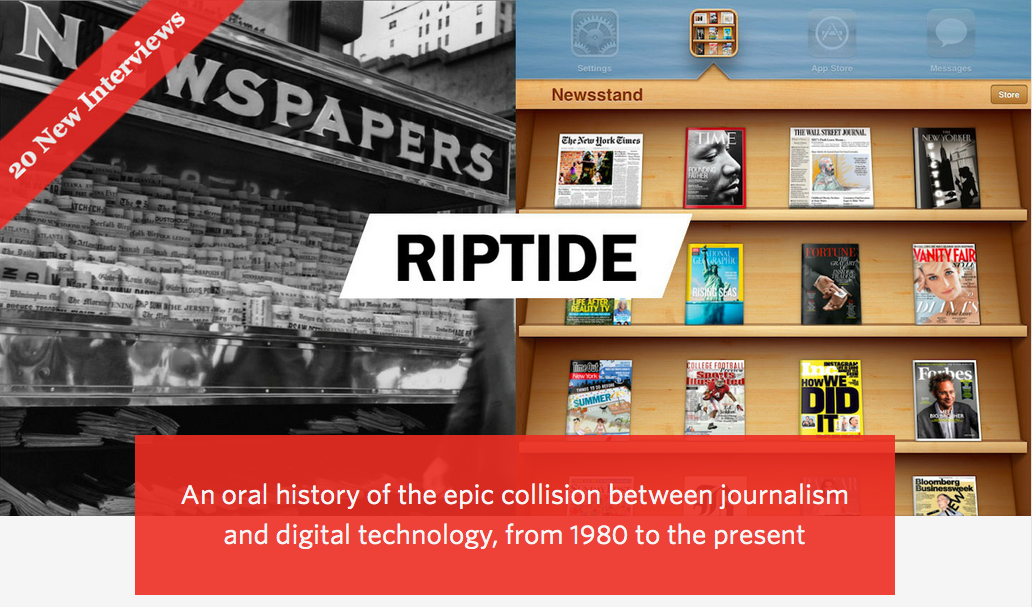
The report from the Shorenstein Center on the transformation of the American news media was aptly titled “Riptide: What Really Happened to the News Business.”

The oral history published in 2013 is still worth a read (and a listen—see below), especially considering the inside knowledge of the report’s authors. John Huey was editor-in-chief of Time Inc. from 2006-2012 during years of digital upheaval in the Time Inc. stable of publications. Paul Sagan was president and editor of new media at Time Inc. from 1995-1997 when American media first started catching on to the threat/opportunity of digital. Martin Nisenholtz was the founding leader of nytimes.com in 1995 and chief executive of New York Times Digital from 1995-2005.

But Riptide is not a static report, it is an ongoing project based on the website www.digitalriptide.org. The website is an amazing repository of information, including videos and transcripts of interviews done for the project and documents such as internal memos about the digital transition written by industry leaders.

digital riptide-blog

An excerpt from Riptide’s Introduction is below, but download the 2013 full report here.

For most of the 20th century, any list of America’s wealthiest families would include quite a few publishers generally considered to be in the “news business”: the Hearsts, the Pulitzers, the Sulzbergers, the Grahams, the Chandlers, the Coxes, the Knights, the Ridders, the Luces, the Bancrofts—a tribute to the fabulous business model that once delivered the country its news. While many of those families remain wealthy today, their historic core businesses are in steep decline (or worse), and their position at the top of the wealth builders has long since been eclipsed by people with other names: Gates, Page and Brin and Schmidt, Zuckerberg, Bezos, Case, and Jobs—builders of digital platforms that, while not specifically targeted at the “news business,” have nonetheless severely disrupted it.

Reasonable people can—and do—debate whether the replacement of legacy media by new forms of information gathering and distribution—including citizen journalism and smartphone photojournalism, crowdsourcing, universal access to data and, of course, a world awash in Twitter feeds—makes democracy more or less vulnerable. Usually the argument is reduced to a couple of symbolic questions: Who’s going to pay for the Baghdad bureau? Who’s going to replace the watchdog function at city hall traditionally provided by healthy metro newspapers?

Not everybody is a fan of the study. Some critics complained that the insider perspective of the authors blinded them to some realities of the digital revolution. For example, they noted that of the 61 movers and shakers initially interviewed for the study, five were (white) women, two were men of color, and zero were women of color.

The authors retort that their study is a work in progress, that 20 new interviews have been added (there are now 12 women listed as interviewees), and that they welcome suggestions for further voices or topics. Email: shorenstein_center@hks.harvard.edu.

—Scott MacLeod

The Journalists’ Bard

It’s a grand, grand caper. You get to leave, go talk to strangers, ask them anything, come back, type up their stories, edit the tape. That’s not gonna retire your loans as quickly as it should, and it’s not going to turn you into a person who’s worried about what kind of car they should buy, but that’s kind of as it should be. I mean, it beats working.

—David Carr (1956-2015)

That’s from David Carr’s commencement address in 2014 at the University of California, Berkeley, Graduate School of Journalism, a paean to his profession that manages to be sentimental and hard-boiled at the same time. As the Media Equation columnist and culture writer for the New York Times, Carr captured the zeitgeist of a world turned upside down by the Internet better than anyone.

“David was a bard for journalists because he figured out how to connect our past with our present,” David Leonhardt wrote in an appreciation in the Times. “He venerated old-fashioned reporting and yet described today as a ‘golden age’ for journalists.”

Carr collapsed in the Times’ newsroom and later died of complications from lung cancer last February, at age 58. He lives on; for example, here in the video of his Berkeley commencement address, as well as in Page One, Andrew Rossi’s great 2011 documentary about the New York Times struggling with the transformation of the news business.

—Scott MacLeod